


Page 179 - Photoreactive Organic Thin Films
P. 179
I JJg                               MIKHAILV. KOZLOVSKY, LEV M. BLINOV, AND WOLFGANG HAASE

                 irradiation with nonpolarized UV light increases drastically the birefringence
                 induced by polarized visible light: An ind=±0.045 for the illuminated film
                 versus An ind=±0.001 for that reached without UV treatment. This gives rise to
                 the possibility of amplifying the sensitivity of the material to visible light by
                 previous exposure to UV light. To some extent, the phenomenon is similar to
                 the "nonvolatile holographic storage effect" observed recently in a doubly
                                           83
                 doped inorganic ferroelectric.  Our data show, however, that the UV sensibi-
                                                                               78 80 84
                 lization is much more pronounced for the copolyrners of the KW series " '
                                              77 81
                 than for the SK and KM series. '  That can be explained by the stronger
                 electron-accepting substituents at the tail of the azobenzene chromophores
                 for the latter two series, -CN for SK copolyrners and -OCF 3 for KM copoly-
                 rners as compared with -OCH 3 for KW copolyrners, which lead to reduced
                 stability and shorter lifetimes for the os-isomers, as reported by Ikeda
                     5
                 etal. *- 52
                     There is one more possibility for substantially increasing the stability of
                 photoinduced birefringence in chiral LC copolyrners. If the light-induced
                 reorientation of photochromic azo groups occurs not in a well-formed
                 (mature) mesophase, but during phase formation, it is less restricted by main--
                 chain conformation, so that higher An values can be achieved. Moreover,
                 corresponding structural reorganization should involve the polymer main
                 chain itself. As a result, its conformation "memorizes" the preferred orienta-
                 tion of chromophores and the thereby-induced cooperative reorientation of
                 colorless mesogenic moieties in glass, and the copolymer film keeps the
                 macroscopic orientation for much longer times. 85
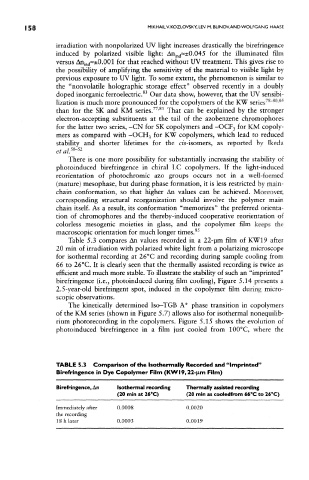
                     Table 5.3 compares An values recorded in a 22-um film of KW19 after
                 20 min of irradiation with polarized white light from a polarizing microscope
                 for isothermal recording at 26°C and recording during sample cooling from
                 66 to 26°C. It is clearly seen that the thermally assisted recording is twice as
                 efficient and much more stable. To illustrate the stability of such an "imprinted"
                 birefringence (i.e., photoinduced during film cooling), Figure 5.14 presents a
                 2.5-year-old birefringent spot, induced in the copolymer film during micro-
                 scopic observations.
                     The kinetically determined Iso-TGB A* phase transition in copolyrners
                 of the KM series (shown in Figure 5.7) allows also for isothermal nonequilib-
                 rium photorecording in the copolyrners. Figure 5.15 shows the evolution of
                 photoinduced birefringence in a film just cooled from 100°C, where the


                 TABLE 5.3 Comparison of the Isothermal!/ Recorded and "Imprinted"
                 Birefringence in Dye Copolymer Film (KW 19,22-um Film)

                 Birefringence, An  Isothermal recording  Thermally assisted recording
                                   (20 min at 26°C)     (20 min as cooledfrom 66°C to 26°C)

                 Immediately after  0.0008              0.0020
                 the recording
                 18 h later        0.0003               0.0019

