


Page 183 - Photoreactive Organic Thin Films
P. 183
162                                 MIKHAIL V. KOZLOVSKY. LEV M. BLINOV, AND WOLFGANG HAASE


                                    10-
                                        s,s -grating
                                     8-
                                     6-
                                     4-
                                 ^ o                          O
                                 c   2-
                                 • 2n  .             " 0
                                 'o     1  o    8    o
                                     0-   i ' '  i  •  •  '  '  i  '  i  •  *
                                 W   6-
                                 c      p,p -grating     Q
                                 .2    I         1        ^"
                                 tj                  O
                                 cd  4-
                                 fi
                                 i3
                                     2-                       m
                                      -              m    *
                                                O
                                     0-    fi •
                                      100      200       300       4(
                                        Writing Beam Intensity, P, mW
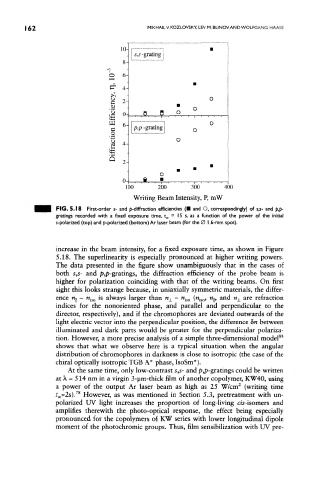
                 FIG. 5.18 First-order s- and p-diffraction efficiencies (• and O, correspondingly) of s,s- and p,p-
                 gratings recorded with a fixed exposure time, t^ = 15 s, as a function of the power of the initial
                 s-polarized (top) and p-polarized (bottom) Ar laser beam (for the 0 1.6-mm spot).


                 increase in the beam intensity, for a fixed exposure time, as shown in Figure
                 5,18. The superlinearity is especially pronounced at higher writing powers.
                 The data presented in the figure show unambiguously that in the cases of
                 both s,s- and p,|>-gratings, the diffraction efficiency of the probe beam is
                 higher for polarization coinciding with that of the writing beams. On first
                 sight this looks strange because, in uniaxially symmetric materials, the differ-
                 ence W| - « iso is always larger than n L - n iso (w iso, n^ and n ± are refraction
                 indices for the nonoriented phase, and parallel and perpendicular to the
                 director, respectively), and if the chromophores are deviated outwards of the
                 light electric vector into the perpendicular position, the difference §« between
                 illuminated and dark parts would be greater for the perpendicular polariza-
                 tion. However, a more precise analysis of a simple three-dimensional model 88
                 shows that what we observe here is a typical situation when the angular
                 distribution of chromophores in darkness is close to isotropic (the case of the
                 chiral optically isotropic TGB A* phase, IsoSm*).
                    At the same time, only low-contrast s,s- and p,p-gratings could be written
                 at X = 514 nm in a virgin 3-um-thick film of another copolymer, KW40, using
                                                                       2
                 a power of the output Ar laser beam as high as 25 W/cm  (writing time
                      7S
                 t w-2s).  However, as was mentioned in Section 5.3, pretreatment with un-
                 polarized UV light increases the proportion of long-living os-isomers and
                 amplifies therewith the photo-optical response, the effect being especially
                 pronounced for the copolymers of KW series with lower longitudinal dipole
                 moment of the photochromic groups. Thus, film sensibilization with UV pre-

