


Page 186 - Photoreactive Organic Thin Films
P. 186
5, CHIRAL POLYMERS WITH PHOTOAFFECTED PHASE BEHAVIOR FOR OPTICAL DATA STORAGE  165

                                 200 T-

                              P"  150
                              s^>
                              o
                              e
                              <u      •
                              "o ioa  «
                              IE
                              w       *
                              c
                              .2  SO-  •
                                       \ %
                              1
                              /"\  rt
                                            10   20    30    40    50
                                                Time, min
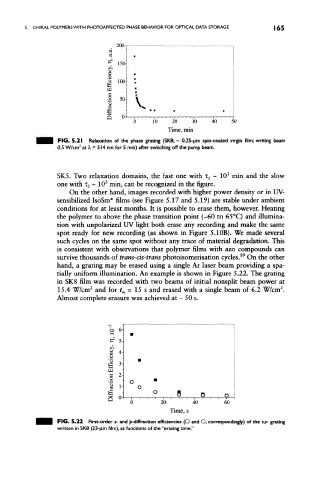
                FIG. 5.21 Relaxation of the phase grating (SK8; ~ 0.25-um spin-coated virgin film; writing beam
                      2
               0.5 W/cm  at X = 514 nm for 5 min) after switching off the pump beam.


                                                                  1
               SK5. Two relaxation domains, the fast one with TJ ~ 10  min and the slow
                              3
               one with T 2 ~ 10  min, can be recognized in the figure.
                   On the other hand, images recorded with higher power density or in UV-
               sensibilized IsoSm* films (see Figure 5.17 and 5.19) are stable under ambient
               conditions for at least months. It is possible to erase them, however. Heating
                                                                   0
               the polymer to above the phase transition point (~60 to 65 C) and illumina-
               tion with unpolarized UV light both erase any recording and make the same
               spot ready for new recording (as shown in Figure 5.10B). We made several
               such cycles on the same spot without any trace of material degradation. This
               is consistent with observations that polymer films with azo compounds can
                                                                      89
               survive thousands of trans-ds-trans photoisomerisation cycles.  On the other
               hand, a grating may be erased using a single Ar laser beam providing a spa-
               tially uniform illumination. An example is shown in Figure 5.22. The grating
               in SK8 film was recorded with two beams of initial nonsplit beam power at
                                                                                 2
                         2
                15.4 W/cm  and for £ w = 15 s and erased with a single beam of 6.2 W/crn .
               Almost complete erasure was achieved at ~ 50 s.


                               b 6-  u
                               f 5-
                               u  4-
                               G
                              i   3-   •
                              w
                               c  2-
                              .2     o      •
                                            •1
                                  1-   o
                              1
                              Jg            0      B      o      o
                              b    H
                                     0        20       40        60
                                                 Time, s
               Fl<3, 5.22  First-order s- and p-diffraction efficiencies (D and O, correspondingly) of the s,s- grating
               written in SK8 (23-u.m film), as functions of the "erasing time."

