


Page 189 - Photoreactive Organic Thin Films
P. 189
MIKHAIL V. KOZLOVSKY, LEV M. BLINOV, AND WOLFGANG HAASE


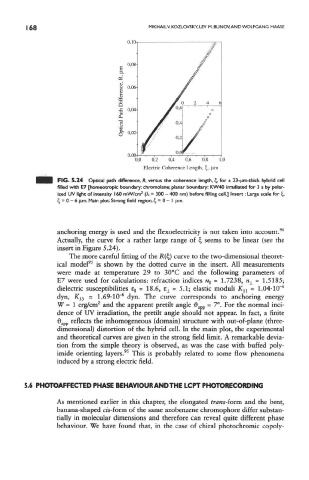
                 FIG. 5.24  Optical path difference, R, versus the coherence length, %, for a 23-um-thick hybrid cell
                 filled with E7 [homeotropic boundary: chromolane; planar boundary: KW40 irradiated for 3 s by polar-
                                          2
                 ized UV light of intensity 160 mW/cm  (A, = 300 - 400 nm) before filling cell.] Insert: Large scale for cj,
                 £, = 0 - 6 |Lim. Main plot: Strong field region, cj = 0 - I jim.


                 anchoring energy is used and the flexoelectricity is not taken into account. 96
                 Actually, the curve for a rather large range of £, seems to be linear (see the
                 insert in Figure 5.24).
                     The more careful fitting of the H(%) curve to the two-dimensional theoret-
                          95
                 ical model  is shown by the dotted curve in the insert. All measurements
                 were made at temperature 29 to 30°C and the following parameters of
                 E7 were used for calculations: refraction indices % = 1.7238, » ± = 1.5185;
                 dielectric susceptibilities EH = 18.6, e ± = 5.1; elastic moduli K n = 1.04-10~ 6
                                    6
                 dyn, K 33 - 1.69' 10"  dyn. The curve corresponds to anchoring energy
                             2
                 W ~ 1 erg/cm  and the apparent pretilt angle d app = 7°. For the normal inci-
                 dence of UV irradiation, the pretiit angle should not appear. In fact, a finite
                 d app reflects the inhomogeneous (domain) structure with out-of-plane (three-
                 dimensional) distortion of the hybrid cell. In the main plot, the experimental
                 and theoretical curves are given in the strong field limit. A remarkable devia-
                 tion from the simple theory is observed, as was the case with buffed poly-
                                     95
                 imide orienting layers.  This is probably related to some flow phenomena
                 induced by a strong electric field.


       5.6 PHOTOAFFECTED PHASE BEHAVIOUR AND THE LCPT PHOTORECORDING

                 As mentioned earlier in this chapter, the elongated trans-form and the bent,
                 banana-shaped cis-form of the same azobenzene chromophore differ substan-
                 tially in molecular dimensions and therefore can reveal quite different phase
                 behaviour. We have found that, in the case of chiral photochromic copoly-

