


Page 190 - Photoreactive Organic Thin Films
P. 190
5, CHIRAL POLYMERS WITH PHOTOAFFECTED PHASE BEHAVIOR FOR OPTICAL DATA STORAGE


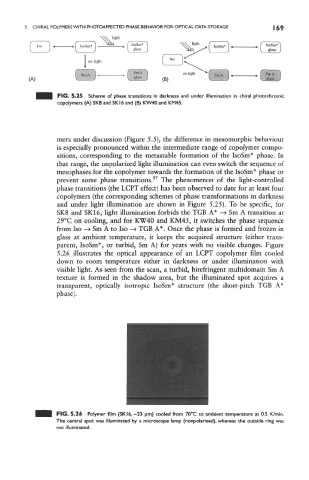
               FIG. 5.25  Scheme of phase transitions in darkness and under illumination in chiral photochromic
               copolymers (A) SK8 and SKI6 and (B) KW40 and KH45.


               mers under discussion (Figure 5.5), the difference in mesomorphic behaviour
               is especially pronounced within the intermediate range of copolymer compo-
               sitions, corresponding to the metastable formation of the IsoSm* phase. In
               that range, the unpolarized light illumination can even switch the sequence of
               mesophases for the copolymer towards the formation of the IsoSm* phase or
                                            97
               prevent some phase transitions.  The phenomenon of the light-controlled
               phase transitions (the LCPT effect) has been observed to date for at least four
               copolymers (the corresponding schemes of phase transformations in darkness
               and under light illumination are shown in Figure 5.25). To be specific, for
               SK8 and SK16, light illumination forbids the TGB A* —> Sm A transition at
               29°C on cooling, and for KW40 and KM45, it switches the phase sequence
               from Iso —> Sm A to Iso —» TGB A*. Once the phase is formed and frozen in
               glass at ambient temperature, it keeps the acquired structure (either trans-
               parent, IsoSm"", or turbid, Sm A) for years with no visible changes. Figure
               5.26 illustrates the optical appearance of an LCPT copolymer film cooled
               down to room temperature either in darkness or under illumination with
               visible light. As seen from the scan, a turbid, birefringent rnultidomain Sm A
               texture is formed in the shadow area, but the illuminated spot acquires a
               transparent, optically isotropic IsoSm* structure (the short-pitch TGB A*
               phase).


               FIG. 5.26  Polymer film (SKI6, ~23 u.m) cooled from 70°C to ambient temperature at 0.5 K/rnin.
               The central spot was illuminated by a microscope lamp (nonpolarized), whereas the outside ring was
               not illuminated.

