


Page 185 - Photoreactive Organic Thin Films
P. 185
164                                 MIKHAIL V. KOZLOVSKY, LEV M. BLINOV, AND WOLFGANG HAASE.


                                                   '"
                                                b
                       O     O
                                                  2,0-
                                               p?                  Q
                                                >,
           2-                                   g  1,5-   D                     D 1
                                               .Sn
                                               'cj       D AIM                  *  ^
                                               IS  1,0-
                                                0
                                                C       D A •»•»                * 4
                                               • 2
                                                  0,5-  •             • • *
                                                        A A  A
                                                f
                                               «       ** .  A A A A A A A A
                                               S 0,0-  <|K *•••• • • •
                                           10                 10     20     30
       (A)            Writing Time, s         (B)             Writing Time, s
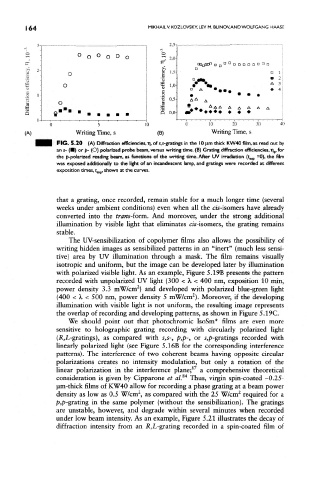
                 FIG. 5.20  (A) Diffraction efficiencies, T\, of s,s-gratings in the 10 (im thick KW40 film, as read out by
                 an s- {•) or p- (O) polarized probe beam, versus writing time. (8) Grating diffraction efficiencies, Tj p, for
                 the p-polarized reading beam, as functions of the writing time. After UV irradiation (t^ =0), the film
                 was exposed additionally to the tight of an incandescent lamp, and gratings were recorded at different
                 exposition times, t , shown at the curves.


                 that a grating, once recorded, remain stable for a much longer time (several
                 weeks under ambient conditions) even when all the ds-isorners have already
                 converted into the ^raws-form. And moreover, under the strong additional
                 illumination by visible light that eliminates cis-isomers, the grating remains
                 stable.
                    The UV-sensibilization of copolymer films also allows the possibility of
                 writing hidden images as sensibilized patterns in an "inert" {much less sensi-
                 tive) area by UV illumination through a mask. The film remains visually
                 isotropic and uniform, but the image can be developed later by illumination
                 with polarized visible light. As an example, Figure 5.19B presents the pattern
                 recorded with unpolarized UV light (300 < A, < 400 nm, exposition 10 min,
                                        2
                 power density 3.3 mW/cm ) and developed with polarized blue-green light
                                                         2
                 (400 < A. < 500 nm, power density 5 mW/cm ). Moreover, if the developing
                 illumination with visible light is not uniform, the resulting image represents
                 the overlap of recording and developing patterns, as shown in Figure 5.19C,
                    We should point out that photochromic IsoSm* films are even more
                 sensitive to holographic grating recording with circularly polarized light
                 (R,,L-gratmgs), as compared with s,s-, /?,/?-, or s,p-gratings recorded with
                 linearly polarized light (see Figure 5.16B for the corresponding interference
                 patterns). The interference of two coherent beams having opposite circular
                 polarizations creates no intensity modulation, but only a rotation of the
                                                         87
                 linear polarization in the interference plane;  a comprehensive theoretical
                                                      m
                 consideration is given by Cipparone et al.  Thus, virgin spin-coated -0.25-
                 um-thick films of KW40 allow for recording a phase grating at a beam power
                                         2                            2
                 density as low as 0.5 W/cm , as compared with the 25 W/cm  required for a
                 p,p-grating in the same polymer (without the sensibilization). The gratings
                 are unstable, however, and degrade within several minutes when recorded
                 under low beam intensity. As an example, Figure 5.21 illustrates the decay of
                 diffraction intensity from an R,L-grating recorded in a spin-coated film of

