


Page 180 - Photoreactive Organic Thin Films
P. 180
5. CH1RAL POLYMERS WITH PHOTOAFFECTED PHASE BEHAVIOR FOR OPTICAL DATA STORAGE  159


               FIG. 5.14 Microphotograph of a 2.5-year-old photorecorded birefringent spot (left) in -20-pm-
               thick film of SK8.


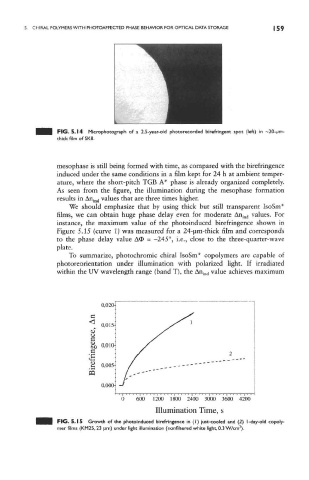
               mesophase is still being formed with time, as compared with the birefringence
               induced under the same conditions in a film kept for 24 h at ambient temper-
               ature, where the short-pitch TGB A* phase is already organized completely.
               As seen from the figure, the illumination during the mesophase formation
               results in An ind values that are three times higher.
                   We should emphasize that by using thick but still transparent IsoSm*
               films, we can obtain huge phase delay even for moderate An ind values. For
               instance, the maximum value of the photoinduced birefringence shown in
               Figure 5.15 (curve 1) was measured for a 24-pm-thick film and corresponds
               to the phase delay value AO = -245°, i.e., close to the three-quarter-wave
               plate.
                   To summarize, photochromic chiral IsoSm* copolymers are capable of
               photoreorientation under illumination with polarized light. If irradiated
               within the UV wavelength range (band T), the An ind value achieves maximum


                            0,020-


                            0,015-

                         So 0,010
                         c

                            0,005-
                         OQ

                            0,000-
                                  0    600 1200 1800 2400 3000 3600 4200
                                            Illumination Time, s
               FIG. 5.15 Growth of the photoinduced birefringence in (/) just-cooled and (2) 1-day-old copoly-
                                                                     2
               mer films (KM25,23 urn) under light illumination (nonfiltered white light, 0.3 W/cm ).

