


Page 173 - Photoreactive Organic Thin Films
P. 173
I 5 2                                MIKHAIL V. KOZLOVSKY, LEV M. BLINOV, AND WOLFGANG HAASE

                     We should state that our suggested model is not completely justified yet,
                 but it remains the only one that can explain the whole ensemble of properties
                 observed for the isotropic smectic phase of P8*M and related polymers.
                 Keeping that in mind, we will refer hereafter to the mesophase as the IsoSm*
                 phase, which most probably has the ultrashort pitch TGB A* structure.


        53 PHOTOINDUCED BIREFRINGENCE IN PHOTOCHROMIC ISOSM* COPOLYMERS

                 Because of the combination of short-scale smectic ordering, transparency,
                 and optical isotropy, the IsoSm* phase is promising for numerous optical and
                 photo-optical applications. We therefore prepared three series of copoly-
                 methacrylates combining the monomer matrix of P8*M with dichroic
                 comonomers based on different azobenzene dyes, namely /?-cyanoazobenzene
                 {SK series), p-mehoxyazobenzene (KW series), and /7-trifluoromethoxy-
                                       73 74
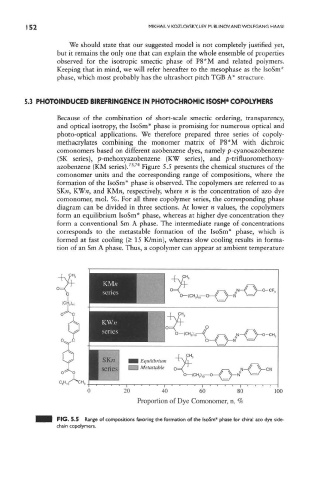
                 azobenzene (KM series). '  Figure 5.5 presents the chemical stuctures of the
                 comonomer units and the corresponding range of compositions, where the
                 formation of the IsoSm* phase is observed. The copolymers are referred to as
                 SK«, KWw, and KMn, respectively, where n is the concentration of azo dye
                 comonomer, mol. %. For all three copolymer series, the corresponding phase
                 diagram can be divided in three sections. At lower n values, the copolymers
                 form an equilibrium IsoSm* phase, whereas at higher dye concentration they
                 form a conventional Sm A phase. The intermediate range of concentrations
                 corresponds to the metastable formation of the IsoSm* phase, which is
                 formed at fast cooling (> 15 K/min), whereas slow cooling results in forma-
                 tion of an Sm A phase. Thus, a copolymer can appear at ambient temperature


                 FIG. 5.5  Range of compositions favoring the formation of the IsoSm* phase for chiral azo dye side-
                 chain copolymers.

