


Page 169 - Photoreactive Organic Thin Films
P. 169
MIKHAIL V. KOZLOVSKY, LEV M. BLINOV, AND WOLFGANG HAASE

                 tures, with an activation energy of about 105 kj/mol. That I-N transition
                 can be accelerated, however, by illumination with visible light (X > 420 nm),
                 ds-to-trans transformation being the rate-determining step of the transition
                                                50
                 process. According to Ikeda et a/,  the presence of electron-donating and
                 -accepting groups in propositions of the azobenzene core increases the rate
                 of the I-N transition, thus shortening the response time (good for switching
                 applications) but reducing the stability (a disadvantage for photorecording
                 applications).
                     It should be also mentioned that the conventional appearance of liquid
                 crystals as a polydomain texture results in remarkable light scattering by the
                 domain boundaries. Special efforts should be taken to produce large trans-
                 parent (monodomain) samples of LC polymers, including shear flow, film
                 stretching, thermal training, external electric or magnetic fields, etc. Such
                 orientation procedures show poor reproducibility, however; they require time
                 and sophisticated equipment. For that reason, it is usual that only thin films
                 of azo dye LC polymers, in which the scattering can be neglected, are investi-
                 gated as photochromic polymer materials. Among those are Langmuir-
                                                                    38 42 5 55
                 Blodgett films consisting of several molecular layej-^ - ' ^  0.05 to
                                            56 58                          26 28 59
                 0.5-Lirn-thick spin-coated films, "  and 1 to 5-tun-thick cast films. " '
                     For all these reasons, our recent discovery of chiral side chain polymers,
                 which appear visually amorphous and optically isotropic but possess some
                 hidden LC ordering, is of particular interest. The structure of that "isotropic
                 smectic" (IsoSm*) phase is not completely determined yet; nevertheless, it
                 was successfully used for the creation of novel azo dye copolymer materials
                 that combine spontaneous transparency with mesomorphic (micro)structure,
                 which incorporates photosensitive moieties. In the next section, we consider
                 the structure and properties of the IsoSm* phase of chiral dichroic copolymers
                 and discuss its application to two types of photorecording. One is related to
                 the photoinduced birefringence in polymer films (holographic grating record-
                 ing), whereas the other is based on the possibility of governing mesomorphic
                 phase transitions in such polymers by light illumination (the light-controlled
                 phase transition—LCPT—recording). Also, we will report an application of
                 such films for contactless orientation of conventional (nematic) liquid
                 crystals.


       5.2 AMORPHOUS, OPTICALLY ISOTROPIC MESOPHASE OF CHIRAL SIDE-CHAIN
       POlYMiRSWITHA HIDDEN LAYER STRUCTURE-THE "ISOTROPIC SMECTIC" PHASE

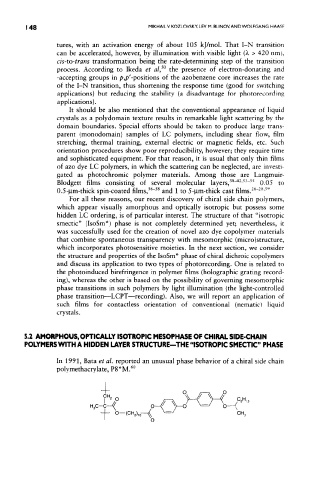
                 In 1991, Bata et al. reported an unusual phase behavior of a chiral side chain
                 polymethacrylate, P8*M. 60

