


Page 346 - Physical chemistry understanding our chemical world
P. 346
ACTIVITY    313

               The ionic atmosphere moves continually, so we consider its com-
                                                                          ‘Associated ions’ in
             position statistically. Crystallization of solutions would occur if the
                                                                          this context means
             ionic charges were static, but association and subsequent dissocia-  an association species
             tion occur all the time in a dynamic process, so even the ions in a  held together (albeit
             dilute solution form a three-dimensional structure similar to that in  transiently) via electro-
             a solid’s repeat lattice. Thermal vibrations free the ions by shaking  static interactions.
             apart the momentary interactions.
               The ions surrounding each copper cation are termed the ionic atmosphere.In the
             neighbourhood of any positively charged ion (such as a copper cation), there are likely
             to be more negative charges than positive (and vice versa). We say the cations are
             surrounded with a shell of anions, and each anion is surrounded by a shell of cations.
             The ionic atmosphere can, therefore, be thought to look much like an onion, or a
             Russian doll, with successive layers of alternate charges, with the result that charges
             effectively ‘cancel’ each other out when viewed from afar.
               Having associated with other ions, we say the copper ion is screened from anything
             else having a charge (including the electrode), so the full extent of its charge cannot be
             ‘experienced’. In consequence, the magnitude of the electrostatic interactions between
             widely separated ions will decrease.
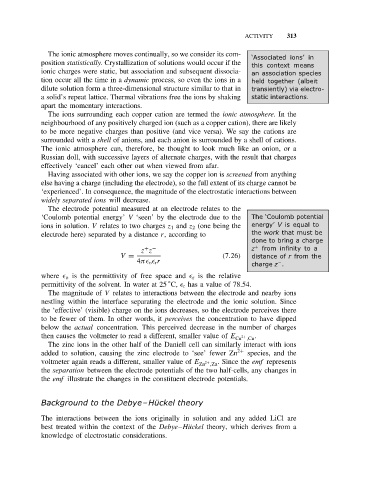
               The electrode potential measured at an electrode relates to the
             ‘Coulomb potential energy’ V ‘seen’ by the electrode due to the  The ‘Coulomb potential
             ions in solution. V relates to two charges z 1 and z 2 (one being the  energy’ V is equal to
             electrode here) separated by a distance r, according to      the work that must be
                                                                          done to bring a charge
                                           + −
                                          z z                             z +  from infinity to a
                                    V =                           (7.26)  distance of r from the
                                         4π  o   r r
                                                                          charge z .
                                                                                  −
             where   o is the permittivity of free space and   r is the relative
                                                  ◦
             permittivity of the solvent. In water at 25 C,   r has a value of 78.54.
               The magnitude of V relates to interactions between the electrode and nearby ions
             nestling within the interface separating the electrode and the ionic solution. Since
             the ‘effective’ (visible) charge on the ions decreases, so the electrode perceives there
             to be fewer of them. In other words, it perceives the concentration to have dipped
             below the actual concentration. This perceived decrease in the number of charges
             then causes the voltmeter to read a different, smaller value of E Cu ,Cu .
                                                                       2+
               The zinc ions in the other half of the Daniell cell can similarly interact with ions
             added to solution, causing the zinc electrode to ‘see’ fewer Zn 2+  species, and the
             voltmeter again reads a different, smaller value of E Zn ,Zn . Since the emf represents
                                                            2+
             the separation between the electrode potentials of the two half-cells, any changes in
             the emf illustrate the changes in the constituent electrode potentials.


             Background to the Debye–H¨ uckel theory

             The interactions between the ions originally in solution and any added LiCl are
             best treated within the context of the Debye–H¨uckel theory, which derives from a
             knowledge of electrostatic considerations.

