


Page 349 - Physical chemistry understanding our chemical world
P. 349
316    ELECTROCHEMISTRY

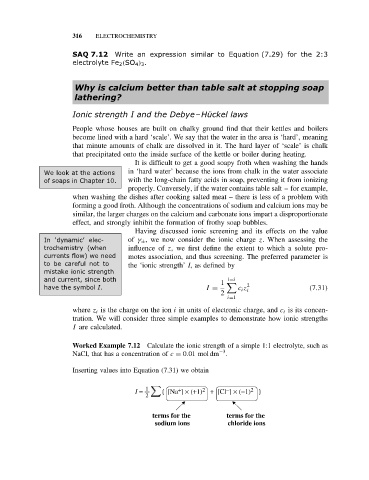
                      SAQ 7.12 Write an expression similar to Equation (7.29) for the 2:3
                      electrolyte Fe 2 (SO 4 ) 3 .


                       Why is calcium better than table salt at stopping soap
                       lathering?

                      Ionic strength I and the Debye–H¨ uckel laws

                      People whose houses are built on chalky ground find that their kettles and boilers
                      become lined with a hard ‘scale’. We say that the water in the area is ‘hard’, meaning
                      that minute amounts of chalk are dissolved in it. The hard layer of ‘scale’ is chalk
                      that precipitated onto the inside surface of the kettle or boiler during heating.
                                        It is difficult to get a good soapy froth when washing the hands
              We look at the actions  in ‘hard water’ because the ions from chalk in the water associate
              of soaps in Chapter 10.  with the long-chain fatty acids in soap, preventing it from ionizing
                                      properly. Conversely, if the water contains table salt – for example,
                      when washing the dishes after cooking salted meat – there is less of a problem with
                      forming a good froth. Although the concentrations of sodium and calcium ions may be
                      similar, the larger charges on the calcium and carbonate ions impart a disproportionate
                      effect, and strongly inhibit the formation of frothy soap bubbles.
                                        Having discussed ionic screening and its effects on the value
              In ‘dynamic’ elec-      of γ ± , we now consider the ionic charge z. When assessing the
              trochemistry (when      influence of z, we first define the extent to which a solute pro-
              currents flow) we need   motes association, and thus screening. The preferred parameter is
              to be careful not to    the ‘ionic strength’ I, as defined by
              mistake ionic strength
                                                                   i=i
              and current, since both                            1
              have the symbol I.                             I =      c i z 2 i            (7.31)
                                                                 2
                                                                   i=1
                      where z i is the charge on the ion i in units of electronic charge, and c i is its concen-
                      tration. We will consider three simple examples to demonstrate how ionic strengths
                      I are calculated.

                      Worked Example 7.12 Calculate the ionic strength of a simple 1:1 electrolyte, such as
                                                                 −3
                      NaCl, that has a concentration of c = 0.01 mol dm .

                      Inserting values into Equation (7.31) we obtain

                                                     +
                                                                   −
                                        I =  1  { [Na ] × (+1) 2  + [Cl ] × (−1) 2  }
                                           2
                                             terms for the         terms for the
                                              sodium ions           chloride ions

