


Page 354 - Physical chemistry understanding our chemical world
P. 354
HALF-CELLS AND THE NERNST EQUATION     321

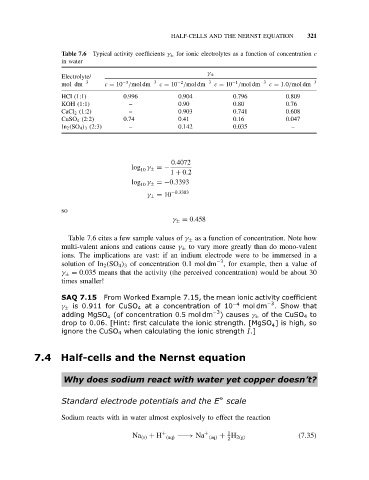
                   Table 7.6 Typical activity coefficients γ ± for ionic electrolytes as a function of concentration c
                   in water
                   Electrolyte/                              γ ±
                                                    −2
                                     −3
                                                                    −1
                   mol dm −3   c = 10 /mol dm −3  c = 10 /mol dm −3  c = 10 /mol dm −3  c = 1.0/mol dm −3
                   HCl (1:1)         0.996           0.904           0.796          0.809
                   KOH (1:1)          –              0.90            0.80           0.76
                   CaCl 2 (1:2)       –              0.903           0.741          0.608
                   CuSO 4 (2:2)      0.74            0.41            0.16           0.047
                   In 2 (SO 4 ) 3 (2:3)  –           0.142           0.035            –


                                                   0.4072
                                       log γ ± =−
                                          10
                                                   1 + 0.2
                                       log γ ± =−0.3393
                                          10
                                            γ ± = 10 −0.3383

                   so
                                                   γ ± = 0.458


                     Table 7.6 cites a few sample values of γ ± as a function of concentration. Note how
                   multi-valent anions and cations cause γ ± to vary more greatly than do mono-valent
                   ions. The implications are vast: if an indium electrode were to be immersed in a
                                                                −3
                   solution of In 2 (SO 4 ) 3 of concentration 0.1 mol dm , for example, then a value of
                   γ ± = 0.035 means that the activity (the perceived concentration) would be about 30
                   times smaller!

                   SAQ 7.15 From Worked Example 7.15, the mean ionic activity coefficient
                   γ ± is 0.911 for CuSO 4 at a concentration of 10  −4  mol dm −3 . Show that
                   adding MgSO (of concentration 0.5mol dm     −3 )causes γ ± of the CuSO 4 to
                                4
                   drop to 0.06. [Hint: first calculate the ionic strength. [MgSO ]ishigh, so
                                                                                4
                   ignore the CuSO 4 when calculating the ionic strength I.]


           7.4     Half-cells and the Nernst equation


                   Why does sodium react with water yet copper doesn’t?


                   Standard electrode potentials and the E scale
                                                                 O
                   Sodium reacts with in water almost explosively to effect the reaction

                                                +           +      1
                                        Na (s) + H (aq) −−→ Na (aq) + H 2(g)            (7.35)
                                                                   2

