


Page 353 - Physical chemistry understanding our chemical world
P. 353
320    ELECTROCHEMISTRY

                                                                                      √
                        From Equation (7.28), we expect a plot of log γ ± (as ‘y’) against  I (as ‘x’)
                                                                  10
                      to be linear. It generally is linear, although it deviates appreciably at higher ionic
                      strengths.

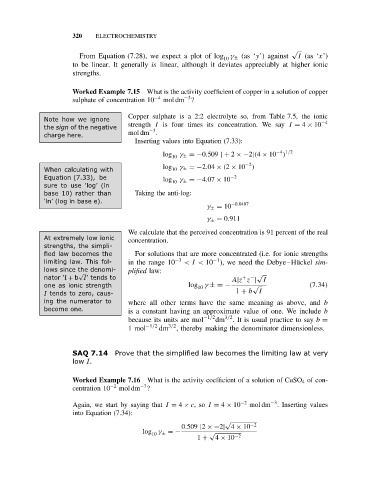
                      Worked Example 7.15 What is the activity coefficient of copper in a solution of copper
                                                       −3
                      sulphate of concentration 10 −4  mol dm ?

                                      Copper sulphate is a 2:2 electrolyte so, from Table 7.5, the ionic
              Note how we ignore                                                              −4
                                      strength I is four times its concentration. We say I = 4 × 10
              the sign of the negative      −3
              charge here.            mol dm .
                                        Inserting values into Equation (7.33):
                                                                                 −4 1/2
                                                log  γ ± =−0.509 |+ 2 ×−2|(4 × 10 )
                                                   10
                                                                        −2
                                                log  γ ± =−2.04 × (2 × 10 )
              When calculating with                10
              Equation (7.33), be               log 10  γ ± =−4.07 × 10 −2
              sure to use ‘log’ (in
              base 10) rather than      Taking the anti-log:
              ‘ln’ (log in base e).                                 −0.0407
                                                             γ ± = 10
                                                             γ ± = 0.911

                                      We calculate that the perceived concentration is 91 percent of the real
              At extremely low ionic
                                      concentration.
              strengths, the simpli-
              fied law becomes the       For solutions that are more concentrated (i.e. for ionic strengths
                                                               −1
              limiting law. This fol-  in the range 10 −3  <I < 10 ), we need the Debye–H¨ uckel sim-
              lows since the denomi-  plified law:
                        √                                                   √
              nator ‘I + b I’tends to                               A|z z | I
                                                                       + −
              one as ionic strength                     log γ ±=−         √                (7.34)
                                                          10
              I tends to zero, caus-                                 1 + b I
              ing the numerator to    where all other terms have the same meaning as above, and b
              become one.
                                      is a constant having an approximate value of one. We include b
                                      because its units are mol −1/2 dm 3/2 . It is usual practice to say b =
                                      1mol −1/2  dm 3/2 , thereby making the denominator dimensionless.


                      SAQ 7.14 Prove that the simplified law becomes the limiting law at very
                      low I.

                      Worked Example 7.16 What is the activity coefficient of a solution of CuSO 4 of con-
                                          −3
                      centration 10 −2  mol dm ?
                                                                                −3
                      Again, we start by saying that I = 4 × c,so I = 4 × 10 −2  mol dm . Inserting values
                      into Equation (7.34):
                                                                  √
                                                      0.509 |2 ×−2| 4 × 10 −2
                                          log γ ± =−          √
                                             10                      −2
                                                          1 +   4 × 10

