


Page 351 - Physical chemistry understanding our chemical world
P. 351
318    ELECTROCHEMISTRY

                      SAQ 7.13 Calculate the relationship between concentration and ionic
                      strength for the 1:3 electrolyte CoCl 3 .

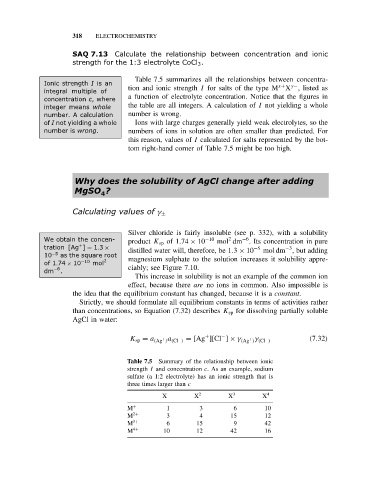
                                        Table 7.5 summarizes all the relationships between concentra-
              Ionic strength I is an                                              x+  y−
              integral multiple of    tion and ionic strength I for salts of the type M X , listed as
                                      a function of electrolyte concentration. Notice that the figures in
              concentration c,where
              integer means whole     the table are all integers. A calculation of I not yielding a whole
              number. A calculation   number is wrong.
              of I not yielding a whole  Ions with large charges generally yield weak electrolytes, so the
              number is wrong.        numbers of ions in solution are often smaller than predicted. For
                                      this reason, values of I calculated for salts represented by the bot-
                                      tom right-hand corner of Table 7.5 might be too high.


                       Why does the solubility of AgCl change after adding
                       MgSO ?
                              4


                      Calculating values of γ ±

                                      Silver chloride is fairly insoluble (see p. 332), with a solubility
              We obtain the concen-   product K sp of 1.74 × 10 −10  mol dm . Its concentration in pure
                                                                       −6
                                                                   2
                        +
                                                                                    −3
              tration [Ag ] = 1.3 ×   distilled water will, therefore, be 1.3 × 10 −5  mol dm , but adding
              10 −5  as the square root  magnesium sulphate to the solution increases it solubility appre-
              of 1.74 × 10 −10  mol 2
              dm −6 .                 ciably; see Figure 7.10.
                                        This increase in solubility is not an example of the common ion
                                      effect, because there are no ions in common. Also impossible is
                      the idea that the equilibrium constant has changed, because it is a constant.
                        Strictly, we should formulate all equilibrium constants in terms of activities rather
                      than concentrations, so Equation (7.32) describes K sp for dissolving partially soluble
                      AgCl in water:


                                                                         + γ
                                                     − = [Ag ][Cl ] × γ
                                                + a
                                       K sp = a (Ag ) (Cl )  +   −     (Ag ) (Cl )         (7.32)
                                                                              −
                                      Table 7.5  Summary of the relationship between ionic
                                      strength I and concentration c. As an example, sodium
                                      sulfate (a 1:2 electrolyte) has an ionic strength that is
                                      three times larger than c
                                                X −      X 2−      X 3−      X 4−

                                      M +        1         3         6        10
                                      M 2+       3         4        15        12
                                      M 3+       6        15         9        42
                                      M 4+      10        12        42        16

