


Page 352 - Physical chemistry understanding our chemical world
P. 352
ACTIVITY    319


                           1.7


                         s (AgCl)/10 −5  mol dm −3  1.6


                           1.5


                           1.4
                                             Solubility of AgCl in pure water


                           1.3
                              0      0.2    0.4     0.6     0.8     1      1.2
                                                  ]/0.01 mol dm −3
                                             [MgSO 4
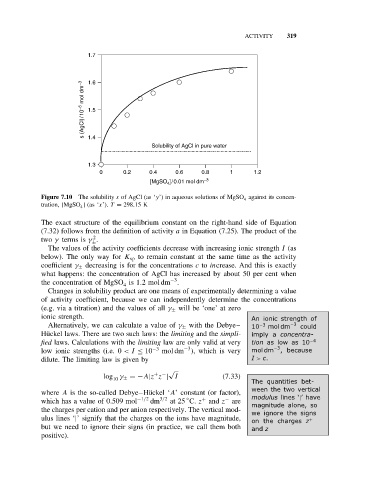
             Figure 7.10 The solubility s of AgCl (as ‘y’) in aqueous solutions of MgSO against its concen-
                                                                        4
             tration, [MgSO ](as ‘x’). T = 298.15 K
                        4
             The exact structure of the equilibrium constant on the right-hand side of Equation
             (7.32) follows from the definition of activity a in Equation (7.25). The product of the
                            2
             two γ terms is γ .
                            ±
               The values of the activity coefficients decrease with increasing ionic strength I (as
             below). The only way for K sp to remain constant at the same time as the activity
             coefficient γ ± decreasing is for the concentrations c to increase. And this is exactly
             what happens: the concentration of AgCl has increased by about 50 per cent when
                                                  −3
             the concentration of MgSO is 1.2 mol dm .
                                     4
               Changes in solubility product are one means of experimentally determining a value
             of activity coefficient, because we can independently determine the concentrations
             (e.g. via a titration) and the values of all γ ± will be ‘one’ at zero
             ionic strength.                                              An ionic strength of
               Alternatively, we can calculate a value of γ ± with the Debye–  10 −3  mol dm −3  could
             H¨ uckel laws. There are two such laws: the limiting and the simpli-  imply a concentra-
             fied laws. Calculations with the limiting law are only valid at very  tion as low as 10 −4
                                                      −3
             low ionic strengths (i.e. 0 <I ≤ 10 −3  mol dm ), which is very  mol dm −3 ,because
             dilute. The limiting law is given by                         I > c.
                                                  √
                                              + −
                               log γ ± =−A|z z | I                (7.33)
                                  10
                                                                          The quantities bet-
                                                                          ween the two vertical
             where A is the so-called Debye–H¨ uckel ‘A’ constant (or factor),
                                                       ◦
                                                                  −
             which has a value of 0.509 mol −1/2  dm 3/2  at 25 C. z and z are  modulus lines ‘|’have
                                                            +
                                                                          magnitude alone, so
             the charges per cation and per anion respectively. The vertical mod-
                                                                          we ignore the signs
             ulus lines ‘|’ signify that the charges on the ions have magnitude,  on the charges z +
             but we need to ignore their signs (in practice, we call them both  and z −
             positive).

