Page 373 - Physical Chemistry
P. 373

lev38627_ch12.qxd  3/18/08  2:41 PM  Page 354


                354
               Chapter 12                    We now specialize to ideally dilute solutions. Here x is very small, and terms in
                                                                                         B
                                          2
               Multicomponent Phase Equilibrium  x and higher powers in (12.10) are negligible compared with the  x term. (If x
                                                                                                    B
                                                                                                              B
                                          B
                                                          4
                                                   2
                                            2
                                         10 , then x   10 .) Thus
                                                   B
                                                              ln  g x   x    ideally dil. soln.            (12.11)
                                                                 A A
                                                                          B
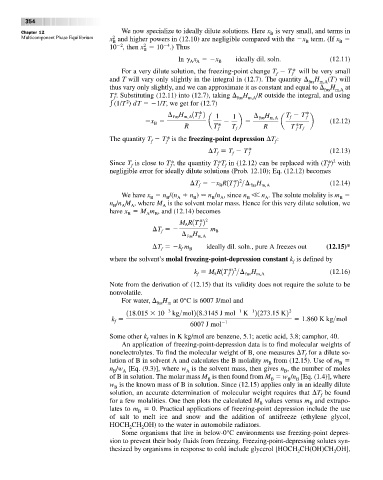
                                             For a very dilute solution, the freezing-point change T   T* will be very small
                                                                                                f
                                                                                           f
                                         and T will vary only slightly in the integral in (12.7). The quantity   H m,A (T) will
                                                                                                     fus
                                         thus vary only slightly, and we can approximate it as constant and equal to   H m,A  at
                                                                                                         fus
                                         T* . Substituting (12.11) into (12.7), taking   H m,A /R outside the integral, and using
                                          f
                                                                               fus
                                              2
                                          (1/T ) dT   1/T, we get for (12.7)
                                                           ¢ H m,A 1T*2  1    1     ¢ H  m,A  T   T*
                                                                                                    f
                                                                                               f
                                                                    f
                                                            fus
                                                                                      fus
                                                     x                 a        b            a       b     (12.12)
                                                      B
                                                                R       T*    T f      R       T*T
                                                                          f
                                                                                                 f  f
                                         The quantity T   T* is the freezing-point depression  T :
                                                      f
                                                                                           f
                                                          f
                                                                       ¢T   T   T*                         (12.13)
                                                                                   f
                                                                         f
                                                                              f
                                                                                                            2
                                         Since T is close to T*, the quantity T*T in (12.12) can be replaced with (T*) with
                                                                            f
                                                           f
                                                                          f
                                                                                                          f
                                                f
                                         negligible error for ideally dilute solutions (Prob. 12.10); Eq. (12.12) becomes
                                                                                2
                                                                 ¢T   x R1T*2 >¢ H     m,A                 (12.14)
                                                                                   fus
                                                                              f
                                                                          B
                                                                    f
                                             We have x   n /(n   n )   n /n , since n V n . The solute molality is m
                                                     B
                                                             A
                                                                          A
                                                                                        A
                                                          B
                                                                  B
                                                                                  B
                                                                                                              B
                                                                        B
                                         n /n M , where M is the solvent molar mass. Hence for this very dilute solution, we
                                             A
                                                A
                                          B
                                                         A
                                         have x   M m , and (12.14) becomes
                                                       B
                                               B
                                                    A
                                                              M R1T*2  2
                                                                A
                                                                    f
                                                      ¢T                 m B
                                                         f
                                                               ¢ H  m,A
                                                                fus
                                                       ¢T   k m    ideally dil. soln., pure A freezes out   (12.15)*
                                                                 B
                                                               f
                                                         f
                                         where the solvent’s molal freezing-point-depression constant k is defined by
                                                                                                f
                                                                              2
                                                                   k   M R1T *2 >¢ H m,A                   (12.16)
                                                                   f
                                                                                  fus
                                                                        A
                                                                             f
                                         Note from the derivation of (12.15) that its validity does not require the solute to be
                                         nonvolatile.
                                             For water,   H at 0°C is 6007 J/mol and
                                                       fus  m
                                                                                    1
                                                                                1
                                                           3
                                              118.015 	 10  kg>mol218.3145 J mol  K 21273.15 K2 2
                                          k                                                       1.860 K kg>mol
                                           f
                                                                 6007 J mol  1
                                         Some other k values in K kg/mol are benzene, 5.1; acetic acid, 3.8; camphor, 40.
                                                    f
                                             An application of freezing-point-depression data is to find molecular weights of
                                         nonelectrolytes. To find the molecular weight of B, one measures  T for a dilute so-
                                                                                                    f
                                         lution of B in solvent A and calculates the B molality m from (12.15). Use of m
                                                                                         B
                                                                                                              B
                                         n /w [Eq. (9.3)], where w is the solvent mass, then gives n , the number of moles
                                          B
                                                                                             B
                                                                A
                                             A
                                         of B in solution. The molar mass M is then found from M   w /n [Eq. (1.4)], where
                                                                                                 B
                                                                                              B
                                                                                         B
                                                                       B
                                         w is the known mass of B in solution. Since (12.15) applies only in an ideally dilute
                                           B
                                         solution, an accurate determination of molecular weight requires that  T be found
                                                                                                        f
                                         for a few molalities. One then plots the calculated M values versus m and extrapo-
                                                                                                     B
                                                                                      B
                                         lates to m   0. Practical applications of freezing-point depression include the use
                                                  B
                                         of salt to melt ice and snow and the addition of antifreeze (ethylene glycol,
                                         HOCH CH OH) to the water in automobile radiators.
                                               2
                                                   2
                                             Some organisms that live in below-0°C environments use freezing-point depres-
                                         sion to prevent their body fluids from freezing. Freezing-point-depressing solutes syn-
                                         thesized by organisms in response to cold include glycerol [HOCH CH(OH)CH OH],
                                                                                                 2
                                                                                                            2
   368   369   370   371   372   373   374   375   376   377   378