


Page 379 - Pipeline Risk Management Manual Ideas, Techniques, and Resources
P. 379
15/354 Risk Management
             If risk estimates are expressed as a single number-a   point   Table 15.10  Fatality risk comparisons
            estimate-that  number is normally an average. An average, of
            course,  means  there  are  many  probable  outcomes  both       Chancefor one individual in a
            higher and lower than this estimate. As a matter of fact, the   Event   50-year period
            average might not be a likely outcome at all, if the underlying
            distribution of all risk values is other than a normal, bell-shaped   Motor vehicle injury   1 in2
                                                                                  1 in 10
            distribution.                              Cancer fatality            I in 123
                                                       Motor vehicle fatality
             If estimates are presented as a range, then the implication is   Fatality by fall (all locations)   1 in 380
            that  the presenter  has  some degree  of  confidence  that  the   Pedestnan fatality (by motor   1 in 870
            “true” value will fall  within that range.  In many statistical   vehicle accident)
            applications, the  degree of confidence is often 90 or  95%,   Fatality by fall (public places)   1 in 1,000
            based on calculations from observed or assumed frequency   Recreational boating fatality   1 in 1,840
            distributions. The range created by the degree of confidence   Fatality from firearms in   I in 10.600
            is very sensitive to the variability of the underlying data. If   public places
            one is asked “What is the failure probability of Pipeline XYZ   Source:  URS  Radian  Corporation, “Environmental Assessment of
            in the next five years, to a 95% percent confidence level?” the   Longhorn Partners Pipeline,” report prepared for US. EPA and DOT,
            answer implies that arange should be offered. Ifwe have a few   September 2000
            leak rate data points that  we  feel represent Pipeline XYZ’s
            future failure potential, we can, with some assumptions, cal-   believes the pipeline will fail several times in the next five
            culate  the  range using accepted  statistical  concepts.  If,  for   years”  (see  the  earlier  risk  perception  discussion),  even
            example, the data show the vast majority of years with no fail-   though the presenter believes the most likely outcome is no
            ures but  one aberrant  year  in which two  failures occurred,   failures for 50 years. See also the discussion of confidence
            then the correct answer might well be “With a 95% percent   limits in Chapter 14.
            confidence level, we believe the number of failures will range   There is widespread agreement among communications spe-
            from no  failures to 5 failures  in the  next  five years.”  This   cialists that expressing individual risks in terms such as
            might be a statistically correct response,  derived from  spe-   are not helpful to most people. Expressions involving relative
            cific calculations,  even  when the point  estimate-our   best   or  comparative values  are  often  suggested  as  alternatives:
            estimate  of  future  failure  potential-suggests   that  statisti-   “about  equal  to  the  chance  of  being  struck  by  lightning.”
            cally, a failure will occur only once every 50 years, for exam-   Combining comparative events is another  suggestion: “less
            ple.  The  95%  confidence  level  requires  that  almost  all   than the chance of simultaneously being struck by  lightning
            possibilities, no matter how remote, are included in the range.   and a meteorite.” There is also a suggestion of risk presenta-
            On hearing the response, many audiences will in fact hear “He   tions in  multiple formats. However,  there is no  widespread


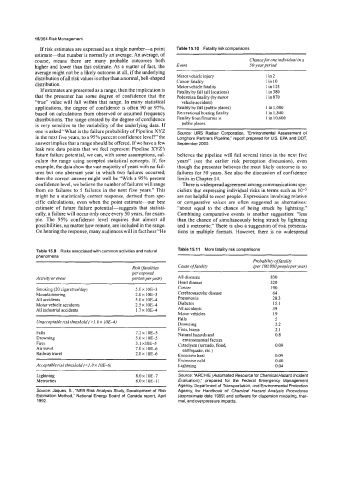
            Table 15.9  Risks associated with common activities and natural   Table 15.1 1  More fatality risk comparisons
            phenomena
                                                                              Probability offatality
                                         Risk Ifatalities   Cause offatality   @er 100,000peopleper.vear)
                                         per exposed
            Activity or event            person per year)   All diseases           830
                                                       Heart disease               320
            Smoking (20 cigarettes/day)   5.0~ 10E-3   Cancer                      190
            Mountaineering                2.0 x 1053   Cerebrovascular disease      64
            All accidents                 5.0~ 10E4    Pneumonia                    28.3
            Motor vehicle accidents       2.5 x 10E4   Diabetes                     15.1
            All industrial accidents      1.7 x 10E4   All accidents                39
                                                       Motor vehicles               19
                                                       Falls                        5
            Unacceptable risk threshold p-1.0~ lOE-4)
                                                       Drowning                     2.2
                                                       Fires, bums                  2.1
            Falls                         7.2 x 10E-5   Natural hazards and         0.8
            Drowning                      5.0~ 10E-5    environmental factors
            Fires                         3.1 x10E-5   Cataclysm (tornado,  flood,   0.09
            Air travel                    7.0 x 10E-6   earthquake, etc.)
            Railway travel                2.0 x 10E-6   Excessive heat              0.09
                                                            ~  ~~.
                                                                                     ~.
                                                       Excessive cold               0.40
            Acceptable risk threshold (cI.0 x 10E-6)   Lightning                    0.04
            Lightning                     8.0 x 1OE-7   Source: “ARCHIE (Automated Resource for Chemical Hazard Incident
            Meteorites                    6.0 x 10E-11   Evaluation),” prepared  for  the  Federal  Emergency  Management
                                                       Agency, Department of  Transportation, and Environmental Protection
            Source: Jaques, S., “NEB Risk Analysis Study, Development of  Risk   Agency,  for Handbook  of  Chemical Hazard  Analysis  Procedures
            Estimation Method,” National  Energy  Board  of  Canada report, April   (approximate date 1989) and software for dispersion modeling, ther-
            1992.                                      mal, and overpressure impacts.

