


Page 384 - Pipeline Risk Management Manual Ideas, Techniques, and Resources
P. 384
Typical pipeline products /359
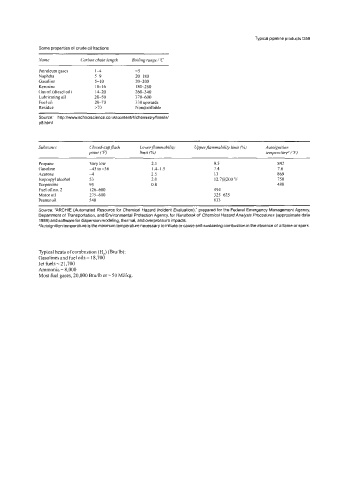
             Some properties of crude oil fractions
             Name        Carbon chain length   Boiling range /'C
             Petroleum gases   14         <5
             Naphtha          5-9         2&180
             Gasoline         5-10        20-200
             Kerosine         10-16       180-260
             Gas oil (diesel oil)   14-20   260-340
             Lubricating oil   2&50       37MOO
             Fuel oil         2&70        330 upwards
             Residue          >70         Nondistillahle
             Source:  http://www.schoolscience.co.uk/conten~4/chemistry/fossils/
             p8.html


             Substance      Closed-cup flash   Lowerflammability   Upperflammability limit (99)   Autoignition
                            point CF)      limit (%)                              temperature? ("F)
             Propane        Very low           2.1                9.5                842
             Gasoline       -45 to -36         1.4-1.5            7.4                7.6
             Acetone        -4                 2.5                13                 869
             Isopropyl alcohol   53            2.0                12.7@200 'F        750
             Turpentine     95                 0.8                                   488
             Fuel oil no. 2   126600                              494
             Motor oil      275400                                325425
             Peanut oil     540                                   833
             Source: "ARCHIE (Automated Resource for Chemical Hazard lncident Evaluation)," prepared for the Federal Emergency Management Agency,
             Department of Transportation, and Environmental Protection Agency, for Handbook  of Chemical Hazard Analysis Procedures (approximate date
             1989) and software for dispersion modeling, thermal, and overpressure impacts.
             aAutoignition temperature is the minimum temperature necessary to initiate or cause self-sustaining combustion in the absence of a flame or spark.


             Typical heats of combustion (H,) (Bhdlb):
             Gasolines and fuel oils = 18,700
             Jet fuels = 21,700
             Ammonia = 8,000
             Most fuel gases, 20,000 Btu/lb or - 50 MJikg.

