


Page 380 - Pipeline Risk Management Manual Ideas, Techniques, and Resources
P. 380
Risk communications 151355
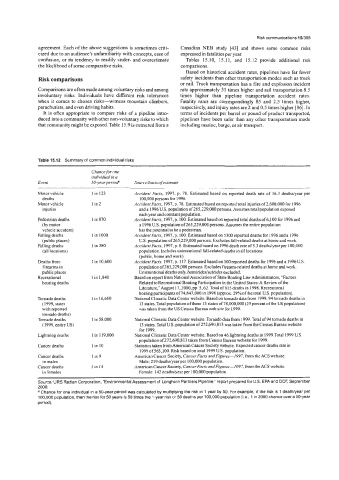
             agreement. Each of the above suggestions is sometimes criti-   Canadian  NEB  study  [43]  and  shows  some  common  risks
             cized due to an audience’s unfamiliarity with concepts, ease of   expressed in fatalities per year.
             confusion, or its tendency to readily under- and overestimate   Tables  15.10,  15.11, and  15.12  provide  additional  risk
            the likelihood of some comparative risks.   comparisons.
                                                         Based on historical accident rates, pipelines have far fewer
             Risk comparisons                           safety incidents than other transportation modes such as truck
                                                        or rail. Truck transportation has a fire and explosion incident
             Comparisons are often made among voluntary risks and among   rate approximately 35 times higher and rail transportation 8.5
             involuntary  risks.  Individuals  have  different  risk  tolerances   times  higher  than  pipeline  transportation  accident  rates.
             when  it comes to chosen risks-witness   mountain  climbers,   Fatality rates  are correspondingly  85 and  2.5 times  higher,
            parachutists, and even driving habits.      respectively, and injury rates are 2 and 0.5 times higher [86]. In
              It is often appropriate to compare risks of a pipeline intro-   terms of incidents per barrel or pound of product transported,
             duced into a community with other non-voluntary risks to which   pipelines have been safer than any other transportation mode
            that community might be exposed. Table 15.9 is extracted from a   including marine, barge, or air transport.


            Table 15.12  Summary of common individual risks
                             Chance for one
                             individual in a
            Event            50-yearperiop   Source/basis ofestimate
            Motor vehicle    1 in 123     Accident Facts,  1997, p.  78. Estimated based  on  reported  death rate of  16.3 deathdyear per
              deaths                       100,000 persons for 1996.
            Motor vehicle    1 m2         Accident Facts, 1997, p. 78. Estimated based on reported total injuries of2,600,000 for 1996
              injuries                     and a 1996 US. population of 265,229,000 persons. Assumes total population exposed
                                           each year and constant population.
            Pedestrian deaths   1 in 870   Accident Facts, 1997, p. 100. Estimated based on reported total deaths of6,IOO for 1996 and
              (by motor                    a 1996 U.S. population of 265,229,000 persons. Assumes the entire population
              vehicle accident)            has the potential to be a pedestrian.
            Falling deaths   I  in 1000   Accident Facts, 1997, p. 100. Estimated based on 5300 reported deaths for 1996 and a 1996
              (public places)              US. population of 265,229,000 persons. Excludes fall-related deaths at home and work.
             Falling deaths   1 in 380    Accidenr Facts, 1997, p. 8. Estimated basedon 1996 death rate of5.3 deathdyearper 100,000
              (all locations)              population. Includes unintentional fall-related deaths in all locations
                                           (public, home and work).
             Deaths from     1 in 10,600   Accident Facts, 1997, p. 11 7. Estimated based on 500 reported deaths for 1996 and a 1996 US
              firearms in                  population of 265,229,000 persons. Excludes firearm-related deaths at home and work.
              public places                Unintentional deaths only, homicidedsuicides excluded.
             Recreational    1 in 1,840   Based on report from National Association of State Boating Law Administrators, “Factors
              boating deaths               Related to Recreational Boating Participation in the United States: A Review ofthe
                                           Literature:’  August 17,2000, pp, 5,62. Total of 815 deaths in 1998. Recreational
                                           boating participants of 74,847,000 in 1998 (approx. 29% ofthe total US. population).
             Tornado deaths   I  in 16,600   National Climatic Data Center website. Based on tornado data from 1999.94 tornado deaths in
              (1999, states                13 states. Total population of these 13 states of 78,000,000 (29 percent of the US population)
              with reported                was taken from the US Census Bureau web site for 1999.
              tornado deaths)
             Tornado deaths   1 in 58,000   National Climatic Data Center website. Tornado data from 1999. Total of 94 tornado deaths in
              (1999, entire US)            13 states. Total U.S. population of 272,690,s 13 was taken from the Census Bureau website
                                           for 1999.
             Lightning deaths   1 in 1 19,000   National Climatic Data Center website. Based on 46 lightning deaths in 1999.Total 1999 US.
                                           population of272,690,813 taken from Census Bureau website for 1999.
             Cancer deaths   1 in IO      Statistics taken from American Cancer Society website. Expected cancer deaths rate in
                                           1999of563,lOO. Riskbasedontotal 1999U.S. population.
             Cancer deaths   1 in9        American Cancer Society, Cancer Facts and Figures-1  997, from the ACS website.
              in males                     Male: 219 deathslyear per 100,000 population.
             Cancer deaths   1 in 14      American Cancer Society, Cancer Facts and Figures-1  997, from the ACS website.
              in females                   Female: 142 deathslyear per 100,000 population.
             Source: URS Radian Corporation, ’Environmental Assessment of  Longhorn Partners Pipeline,” report prepared for US. EPA and DOT, September
             2000.
             a Chance for one individual in a 50-year period was calculated by  multiplying the risk in  1 year by 50. For example, if  the risk is 1 death/year per
             100,000 population, then the risk for 50 years is 50 times the 1-year risk or 50 deaths per 100,000 population &e.. 1 in 2000 chance over a 50-year
             period).

