


Page 398 - Pipeline Risk Management Manual Ideas, Techniques, and Resources
P. 398
Sample algorithms 1373
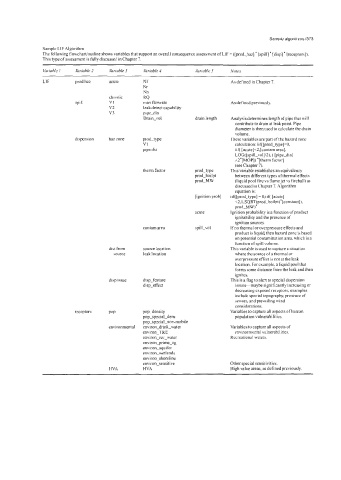
              Sample LIFAlgorithm
              The following flowchartioutline shows variables that support an overall consequence assessment of LIF = ([prod-haz]  * [spill] * [disp] * [receptors]).
              This type of assessment is fully discussed in Chapter 7.
              Vuriahle I   Vnriahle 2   Vnrrable 3   Chriable 4   Variable 5   Notes
              LIF       prod haz   acute     Nf                        As defined in Chapter 7
                                             Nr
                                             Nh
                                  chronic    RQ
                        spill     VI         max flowrate              As defined previously.
                                  v2         leak detect capability
                                  v3         pipe-dia
                                             Drain-vol      drain length   Analysis determines length ofpipe that will
                                                                        contribute to drain at leak point. Pipe
                                                                         diameter is then used to calculate the drain
                                                                         volume.
                        dispersion   haz zone   prod-type              These variables are part ofthe hazard zone
                                             VI                         calculation: iif([prod-type]=O,
                                             pipe dia                    iif( [acute]<2,[contam area],
                                                                         LOG([spill-vol]/2),  ( [pipe-dial
                                                                         A~'[MOP]) '[therm factor]
                                                                         (see Chapter 7).
                                             them factor    prod-type   This variable establishes an equivalency
                                                            prod-hoilpt   between different types ofthermal effects
                                                            prod-MW      (liquid pool fire vs flame jet vs fireball) as
                                                                         discussed in Chapter 7. Algorithm
                                                                        equation is:
                                                            [ignition proh]   iif([prod_type] = O,iif( [acute]
                                                                         <2,1 ,SQRT(prod_boilpt)'[constant] ),
                                                                         prod-MW)'
                                                            acute      Ignition probability is a function ofproduct
                                                                         ignitahility and the presence of
                                                                         ignition sources.
                                             contam area    spill-vol   Ifno thermal or overpressure effects and
                                                                        product is liquid, then hazard zone is based
                                                                         on potential contamination area, which is a
                                                                        function of spill volume.
                                  dist from   source location          This variable is used to capture a situation
                                    \ource   leak location               where the source of a thermal or
                                                                        overpressure effect is not at the leak
                                                                         location. For example, a liquid pool that
                                                                         forms some distance from the leak and then
                                                                         ignites.
                                  disp issue   disp-feature            This is a flag to alert to special dispersion
                                             disp-effect                 issues-maybe  significantly increasing or
                                                                         decreasing exposed receptors; examples
                                                                         include special topography, presence of
                                                                         sewers, and prevailing wind
                                                                         considerations.
                        receptors   POP      pop-density               Variables to capture all aspects of human
                                             pop-special-dens            population vulnerabilities.
                                             pop-special-non-mobile
                                  environmental   environ-drink-water   Variables to capture all aspects of
                                             environ-T&E                 environmental vulnerabilities.
                                             environ-rec-water         Recreational waters.
                                             environ-prime-ag
                                             environ-aquifer
                                             environ-wetlands
                                             environ-shoreline
                                             environ-sensitive         Other special sensitivities.
                                  H VA       HVA                       High value areas; as defined previously

