


Page 395 - Pipeline Risk Management Manual Ideas, Techniques, and Resources
P. 395
370 Sample Pipeline Risk Assessment Algorithms
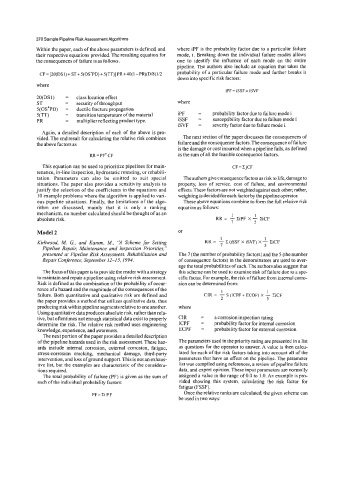
            Within the paper, each of the above parameters is defined, and   where iPF is the probability factor due to a particular failure
            their respective equations provided. The resulting equation for   mode, i. Breaking down the individual failure modes allows
            the consequences of failure is as follows.   one  to  identify  the  influence  of  each  mode  on  the  entire
                                                       pipeline. The authors also include an equation that takes the
             CF = [20(DS1) + ST + 5(OS’PD) + 5(TT)] PR +40( 1 - PR)(D/8)1/2   probability of a particular  failure mode and further breaks it
                                                       down into specific risk factors:
            where
                                                                     iPF = iSSF x iSVF
            20(DS 1)   =   class location effect
            ST       =   security of throughput        where
            5(OS*PD)   =   ductile fracture propagation
            5CW      =   transition temperature of the material   iPF   =   probability factor due to failure mode i
            PR       =   multiplier reflecting product type.   iSSF   =   susceptibility factor due to failure mode i
                                                       iSVF   =   severity factor due to failure mode i.
              Again, a detailed description  of each of the above is pro-
            vided. The end result for calculating the relative risk combines   The next section of the paper discusses the consequences of
            the above factors as                       failure and the consequence factors. The consequence of failure
                                                       is the damage or cost incurred when a pipeline fails, as defined
                            RR=PF*CF                   as the sum ofall the feasible consequence factors.
              This equation can be used to prioritize pipelines for main-   CF = Z jCF
            tenance, in-line inspection, hydrostatic retesting, or rehabili-
            tation.  Parameters  can  also  be  omitted  to  suit  special   The authors give consequence factors as risk to life, damage to
            situations. The paper also provides a sensitivity analysis to   property, loss of  service, cost  of  failure, and  environmental
            justify the selection of the coefficients in the equations and   effects.  These factors are not weighted against each other; rather,
            10 example problems where the algorithm is applied to vari-   weighting is decided for each factor by the pipeline operator.
            ous pipeline situations. Finally, the limitations of the algo-   These above equations combine to form the full relative risk
            rithm  are  discussed,  mainly  that  it  is  only  a  ranking   equation as follows:
            mechanism, no number calculated should be thought of as an   1    1  .
            absolute risk.                                         RR =  - ZiPF  X - ZICF
                                                                       7      5
            Model 2                                    or
                                                                    I            1  .
                                                                     Z
            Kirkwood,  M.  G.,  and  Kamm,  M..  ‘2 Scheme for  Setting   RR = - (ISSF X  iSVF) X - ZICF
              Pipeline  Repair;  Maintenance and  Inspection  Priorities,”   7   5
             presented at Pipeline Risk Assessment, Rehabilitation and   The 7 (the number ofprobability factors) and the 5 (the number
              Repair Conference, September 12-15,1994.   of consequence factors) in the denominators are used to aver-
                                                       age the total probabilities of each. The authors also suggest that
              The focus of this paper is to provide the reader with a strategy   this scheme can be used to examine risk of failure due to a spe-
            to maintain and repair a pipeline using relative risk assessment.   cific factor. For example, the risk of failure from internal corro-
            Risk is defined as the combination of the probability of occur-   sion can be determined from:
            rence of a hazard and the magnitude of the consequences of the
                                                                                  1
                                                                                     .
                                                                    1
            failure. Both quantitative and qualitative risk are defined and   CIR = - (ICPF + ECOF) X - ZICF
                                                                      S
            the paper provides a method that utilizes qualitative data, thus   2   5
            producing risk within pipeline segments relative to one another.   where
            Using quantitative data produces absolute risk, rather than rela-
            tive, but oftentimes not enough statistical data exist to properly   CIR   =   a corrosion inspection rating
            determine the risk. The relative risk method uses engineering   ICPF   =   probability factor for internal corrosion
            knowledge, experience, and awareness.      ECPF   =   probability factor for external corrosion.
              The next portion of the paper provides a detailed description
            of the pipeline hazards used in the risk assessment. These haz-   The parameters used in the priority rating are presented in a list
            ards include  internal  corrosion,  external  corrosion,  fatigue,   as questions for the operator to answer. A value is then calcu-
            stress-corrosion  cracking,  mechanical  damage,  third-party   lated for each of the risk factors taking into account all of the
            intervention, and loss of ground support. This is not an exhaus-   parameters that have an effect on the pipeline. The parameter
            tive list, but the examples are characteristic of the considera-   list was compiled using references, a review of pipeline failure
            tions required.                            data, and expert opinion. These input parameters are normally
              The total probability of failure (PF) is given as the sum of   assigned a value in the range of 0.0 to 1 .O. An example is pro-
            each of the individual probability factors:   vided  showing  this  system,  calculating  the  risk  factor  for
                                                       fatigue (FSSF).
                             PF=ZiPF                     Once the relative ranks are calculated, the given scheme can
                                                       be used in two ways:

