


Page 396 - Pipeline Risk Management Manual Ideas, Techniques, and Resources
P. 396
Sample algorithms /371
             1.  Pipeline  rating-prioritizing   pipelines  for  a  particular   damages, the role ofpipe strength, the potential for internal cor-
               maintenance action                       rosion, and potential  consequences (LIF). Words in brackets
             2.   Failure-mode rating-applying  the scheme to one pipeline   represent risk variables. Brackets identify variables for some
               and determining and prioritizing the most likely causes of   versions of SQL software. Variables multiplied by factors are
               failure and implementing a maintenance program to prevent   normally done to weight the importance or to convert some
               these failure causes.                    measurement (such as deDth of cover in feet) to a Doint score.
                                                                                    ,
                                                                                        -
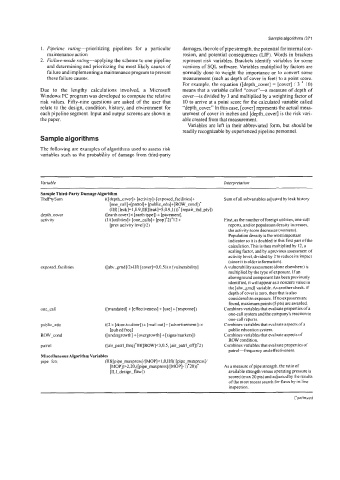
                                                        For example, the equation ([depth-cover]  = [cover] / 3  *  IO)
             Due  to  the  lengthy  calculations  involved,  a  Microsoft   means that a variable called "cover''-a   measure of depth of
             Windows PC program was developed to compute the relative   cover-is   divided by 3 and multiplied by a weighting factor of
             risk values. Fifty-nine questions are asked of the user that   IO to arrive at a point score for the calculated variable called
             relate to the design, condition, history, and environment for   "depth-cover."  In this case, [cover] represents the actual meas-
             each pipeline segment. Input and output screens are shown in   urement of cover in inches and [depth-cover]  is the risk vari-
             the paper.                                 able created from that measurement.
                                                          Variables are left in their abbreviated form, but  should be
                                                        readily recognizable by experienced pipeline personnel.
             Sample algorithms
             The following are examples of algorithms used to assess risk
             variables such as the probability of damage from third-party


             Variable                                                Interpretation
             Sample Third-party Damage Algorithm
             ThdF'tySum          (([depth-cover]+ [activity]+[exposed-facilities]+   Sum of all subvariables adjusted by leak history
                                  [one-call]+[patrol]+  [public-edn]+[ROW-condl)'
                                  (IIf( [leak]=l,0.9,IIf([leak]=5,0.9,1)))'  [repair-thd-pty])
             depth-cover         ([earth cover] x [earth type]) + [pavement]
             activity            (l/([utilities]+ [one-calk]+  [pop]'2)*12 +   First, as the number of foreign utilities, one-call
                                  [prev activity IevelIR)             reports, and/or population density increases,
                                                                      the activity score decreases (worsens).
                                                                      Population density is the most important
                                                                      indicator so it is doubled in this first part of the
                                                                      calculation. This is then multiplied hy 12, a
                                                                      scaling factor, and by a previous assessment of
                                                                      activity level, divided by 2 to reduce its impact
                                                                      (since it is older information).
             exposed-facilities   ([ab\._gmd]/2+Ilf( [cover]=0,0,5)) x [vulnerability]   A vulnerability assessment (done elsewhere) is
                                                                      multiplied by the type of exposure. If an
                                                                      aboveground component has been previously
                                                                      identified, it will appear as a nonzero value in
                                                                      the [abv-grnd] variable. As another check. if
                                                                      depth of cover is zero, then that is also
                                                                      considered an exposure. If no exposures are
                                                                      found, maximum points (5 pts) are awarded.
             one-call            ([mandated] + [effectiveness] + [use] + [response])   Combines variables that evaluate properties of a
                                                                      one-call system and the company's reaction to
                                                                      one-call reports.
             public-edn          ((2 x [door-to-door]) + [mail out] +[advertisement]) x   Combines variables that evaluate aspects of a
                                  [pub ed fieq]                       public education system.
             ROW-cond            ([undergrowth] + [overgrowth] + [signs/markers])   Combines variables that evaluate aspects of
                                                                      ROW condition.
             patrol              ([air_patrl_freq]'Ilf( [ROW]<3  ,O. 5, [air_patrl_effl)*2)   Combines variables that evaluate properties of
                                                                      patrol-frequency  and effectiveness.
             Miscellaneous Algorithm Variables
             pipe-fctr.          (Ilf( [pipe-maxpress]/[MOP]< 1 ,0,IIf(( [pipe-maxpress]/
                                  [MOP])>2,20,(  [pipe-maxpress]/[MOP]-l)*20))'   As a measure of pipe strength, the ratio of
                                  [ILI-design-flaw])                  available strength versus operating pressure is
                                                                      scored (max 20 pts) and adjusted by the results
                                                                      ofthe most recent search for flaws by in-line
                                                                      inspection.
                                                                                          Continued

