


Page 397 - Pipeline Risk Management Manual Ideas, Techniques, and Resources
P. 397
372 Sample Pipeline Risk Assessment Algorithms

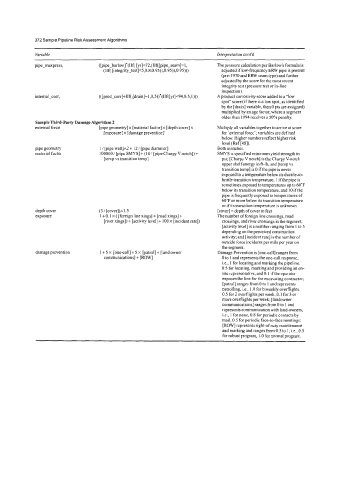
            Variable                                               Interpretation cont’d
            pipe-maxpress,     ([pipe-barlow]’(IIf(  [yr]<72,(1lf([pipe_seam]= I,   The pressure calculation per Barlow’s formula is
                                 (IIf( [integrity-test]<5,0.8,0.95)),0.95)),0.95)))   adjusted if low-frequency ERW pipe is present
                                                                     (pre- 1970 and ERW seam type) and further
                                                                     adjusted by the score for the most recent
                                                                     integrity test (pressure test or in-line
                                                                     inspection).
            internal-con;      (([prod-corr]+IIf(  [drain]=l,O,5))’(lIf([yr]~94,0.5, I)))   A product corrosivity score added to a “low
                                                                     spot” score (ifthere is a low spot, as identified
                                                                     by the [drain] variable, then 0 pts are assigned)
                                                                     multiplied by an age factor, where a segment
                                                                     older than 1994 receives a 50% penalty.
            Sample Third-party Damage Algorithm 2
            external force     [pipe geometry] x [material factor] x [depth cover] x   Multiply all variables together to anive at score
                                 [exposure] x [damage prevention]    for ‘external force’; variables are defined
                                                                     below. Higher numbers reflect higher risk
                                                                     level (Ref[48]).
            pipe geometry      1 /[pipe wall1~2 + 12 / [pipe diameter]   Both in inches.
            material factor    1OOOOO/[pipeSMYS]+(10/[pipeCharpyVnotch])t   SMYS is specified minimum yield strength in
                                 [temp vs transition temp]           psi; [Charpy Vnotch] is the Cbarpy V-notch
                                                                     upper shelf energy in ft-lb, and [temp vs
                                                                     transition temp] is 0 ifthe pipe is never
                                                                     exposed to a temperature below its ductile-to-
                                                                     brittle transition temperature, 1 if the pipe is
                                                                     sometimes exposed to temperatures up to 60’F
                                                                     below its transition temperature, and 10 ifthe
                                                                     pipe is frequently exposed to temperatures of
                                                                     60’F or more below its transition temperature
                                                                     or if its transition temperature is unknown.
            depth cover        (3/[cover])~l.5                     [cover]  = depth of cover in feet
            exposure           1 + 0. I  x ( [foreign line xings] + [road xings] +   The number of foreign line crossings, road
                                 [river xings]) + [activity level] + 100 x [incident rate])   crossings, and river crossings in the segment;
                                                                     [activity level] is a number ranging from 1 to 5
                                                                     depending on the perceived construction
                                                                     activity; and [incident rate] is the number of
                                                                     outside force incidents per mile per year on
                                                                     the segment.
            damage prevention   1 + 5 x [one-call] + 5 x  [patrol] + [land ownei   Damage Prevention is [one-call] ranges from
                                 communications] + [ROW]             0 to 1 and represents the one-call response,
                                                                     Le., 1 for locating and marking the pipeline,
                                                                     0.5 for locating, marking and providing an on-
                                                                     site representative, and 0.1 if the operator
                                                                     exposes the line for the excavating contractor;
                                                                     [patrol] ranges from 0 to 1 and represents
                                                                     patrolling, i.e., 1 .O for biweekly overflights,
                                                                     0.5 for 2 overflights per week, 0.1 for 3 or
                                                                     more overflights per week; [landowner
                                                                     communications] ranges from 0 to 1 and
                                                                     represents communication with land-owners,
                                                                     i.e., 1 for none, 0.8 for periodic contacts by
                                                                     mail, 0.5 for periodic face-to-face meetings;
                                                                     [ROW] represents right-of-way maintenance
                                                                     andmarkingandrangesfrom0.5 to l,i.e.,0.5
                                                                     for robust program, 1 .O for normal program.

