


Page 392 - Pipeline Risk Management Manual Ideas, Techniques, and Resources
P. 392
Appendix D
                                                    Surge Pressure

                                                    Calculations


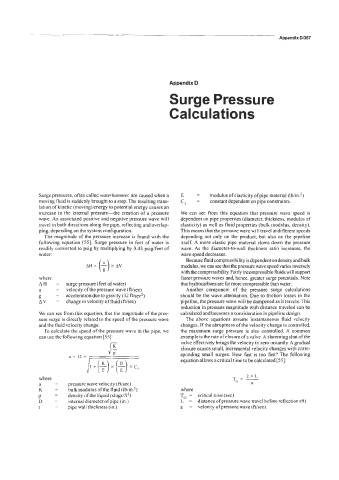
             Surge pressures, often called waterhamme< are caused when a   E   =   modulus ofelasticity ofpipe material (Ib/in.2)
             moving fluid is suddenly brought to a stop. The resulting trans-   C,   =   constant dependent on pipe constraints.
             lation of kinetic (moving) energy to potential energy causes an
             increase  in  the  internal  pressure-the   creation  of a pressure   We  can  see  from  this  equation  that  pressure  wave  speed  is
             wave. An associated positive and negative pressure wave will   dependent on pipe properties (diameter, thickness, modulus of
             travel in both directions along the pipe, reflecting and overlap-   elasticity) as well as fluid properties (bulk modulus, density).
             ping, depending on the system configuration.   This means that the pressure wave will travel at different speeds
              The magnitude  of the pressure increase is found with the   depending  not  only on the product,  but  also on the pipeline
             following  equation [55]. Surge pressure in feet  of  water  is   itself. A more elastic pipe material  slows down the pressure
             readily converted to psig by multiplying by 0.43 psig/feet  of   wave. As the  diameter-to-wall thickness  ratio  increases, the
             water:                                     wave speed decreases.
                               t 1                       Because fluid compressibility is dependent on density and bulk
                           AH=  - XAV                   modulus, we can see that the pressure wave speed varies inversely
                                                        with the compressibility. Fairly incompressible fluids will support
             where                                      faster pressure waves and, hence, greater surge potentials. Note
             AH   =   surge pressure (feet of water)    that hydrocarbons are far more compressible than water.
             a    =   velocity ofthe pressure wave (Wsec)   Another  component  of  the  pressure  surge  calculations
             g    =  acceleration due to gravity (32 ft/sec2)   should be the wave attenuation. Due to friction losses in the
             A V   =  change in velocity of fluid (Wsec)   pipeline, the pressure wave will be dampened as it travels. This
                                                        reduction in pressure magnitude with distance traveled can be
             We can see from this equation, that the magnitude of the pres-   calculated and becomes a consideration in pipeline design.
             sure surge is directly related to the speed of the pressure wave   The  above equations  assume  instantaneous  fluid  velocity
             and the fluid velocity change.             changes. If the abruptness of the velocity change is controlled,
               To calculate the speed of the pressure wave in the pipe, we   the maximum  surge pressure  is also controlled. A  common
             can use the following equation [55]        example is the rate of closure of a valve. A slamming shut ofthe
                                                        valve effectively brings the velocity to zero instantly. A gradual
                                                        closure causes small, incremental velocity changes with corre-
                      a  =  12 x                        sponding  small surges.  How  fast  is too  fast? The following
                                                        equation allows a critical time to be calculated {SS]:

                                                                            2XL
             where                                                      T,,  = -
             a    =   pressure wave velocity (Wsec)                          a
             K    =   bulk modulus ofthe fluid (Ib/im2)   where
             p    =   density of the liquid (slugs/ft2)   T,,  =  critical time (sec)
             D    =   internal diameter ofpipe (in.)    L   =  distance ofpressure wave travel before reflection (ft)
             t    =   pipe wall thickness (in.)         a   =  velocity of pressure wave (Wsec).

