


Page 390 - Pipeline Risk Management Manual Ideas, Techniques, and Resources
P. 390
Other considerations 1365
             If the pipe is considered to be unrestrained longitudinally, the   In general, flexible pipes are less susceptible to damage from
           longitudinal stress is numerically equal to about one-half of the   these causes because the pipe can deflect and adjust to chang-
           hoop stress. In most cases, the actual stress situation is some-   ing lateral supports. In the case of either flexible  or rigid pipes,
           where between the totally restrained and totally unrestrained   design considerations must be given.
           conditions. A rule of thumb for buried steel pipelines shows   Beam formulas are usually used to calculate bending stresses.
           that the longitudinal stress generated by internal pressure can   Assumptions are made as to the end conditions because this is a
           be approximated by [90]:                   critical aspect of the beam calculations. Whether or not the pipe
                                                      is free to move in the longitudinal direction determines how
                           S, =0.45 x S,              much  bending  stress  is  generated. In  the  case  of  buried
                                                      pipelines, the end condition-the  freedom of movement in the
             where S, =longitudinal stress and S,= tangential stress.   longitudinal direction-+  dependent on the amount of pipe-to-
             Longitudinal  stresses also occur as a result of differential   soil bonding and on the pipeline configuration (nearby bends or
           temperatures. These stresses can be calculated from:   valves may act as anchors to restrict movements).
                                                        A  compressive bending  reduces  the  longitudinal  stress
                         0 temp =-a (AT) X E          induced by pressure. A tensile bending stress is directly addi-
           where                                      tive to the longitudinal stress induced by pressure. In general,
           0 temp   =  temperature-induced longitudinal stress   hoop stresses are independent from longitudinal stresses. This
           a     =   linear coefficient of expansion   means that the most severe stress will govern-the  stresses are
           AT    =  temperature change                not additive. A third category of pipe stresses is radial stress.
           E     =  modulus of elasticity of pipe material.   Radial stresses are usually considered to be negligible in com-
                                                      parison with hoop and longitudinal stresses.
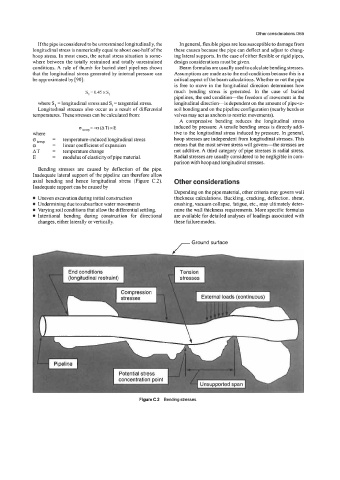
             Bending  stresses  are  caused  by  deflection of  the  pipe.
           Inadequate lateral support of the pipeline can therefore allow
           axial  bending  and  hence  longitudinal  stress  (Figure C.2).   Other considerations
           Inadequate support can be caused by
                                                      Depending on the pipe material, other criteria may govern wall
             Uneven excavation during initial construction   thickness calculations. Buckling,  cracking, deflection, shear,
             Undermining due to subsurface water movements   crushing, vacuum collapse, fatigue, etc., may ultimately deter-
             Varying soil conditions that allow the differential settling.   mine the wall thickness requirements. More specific formulas
             Intentional  bending  during  construction  for  directional   are available for detailed analyses of loadings associated with
             changes, either laterally or vertically.   these failure modes.


                                            Figure C.2  Bending stresses

