


Page 188 - Plant design and economics for chemical engineers
P. 188
162  PLANT DESIGN AND ECONOMICS FOR CHEMICAL ENGINEERS

        TABLE 2
        Typical average costs for making estimates  (199O)t

                                   Less than    $2,ooo,ooo  to  $10,ooo,ooo  to
        Cost of project            $2,ooo,ooo   $10,ooo,000   $loO,OOO,ooO
        Order-of-magnitude  estimate  $  3,000    $ 6,000       $   13,ooo
        Study estimate                20,000       40,000          60,000
        Preliminary  estimate         50,000       80,000         130,000
        Definitive  estimate          80,000      160,000         320,000
        Detailed  estimate           200,000      520,000        1,000,000
        t  Adapted from A. Pikulik and H. E. Diaz,  Cost Estimating for Major Process Equipment, Chem.
        Eng.,   84(21):106  (Oct. 10, 1977).

        4. Definitive estimate (project control estimate) based on almost complete data
          but before completion of drawings and specifications; probable accuracy of
           estimate within f  10 percent.
        5. Detailed estimate (contractor’s estimate) based on complete engineering
           drawings, specifications, and site surveys; probable accuracy of estimate
          within  +5  percent.

             Figure 6-4 shows the relationship between probable accuracy and quantity
        and quality of information available for the preparation of these five levels of
        estimates.? The approximate limits of error in this listing are plotted and show
        an envelope of variability. There is  arge probability that the actual cost will be
                                    iyI/
        more than the estimated cost where information is incomplete or in time of
        rising-cost trends. For such estimates, the positive spread is likely to be wider
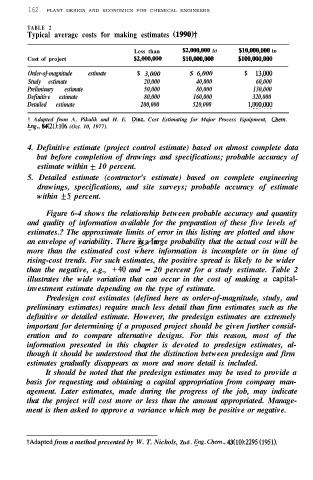
        than the negative, e.g., +40  and -  20 percent for a study estimate. Table 2
        illustrates the wide variation that can occur in the cost of making a capital-
        investment estimate depending on the type of estimate.
             Predesign cost estimates (defined here as order-of-magnitude, study, and
        preliminary estimates) require much less detail than firm estimates such as the
        definitive or detailed estimate. However, the predesign estimates are extremely
        important for determining if a proposed project should be given further consid-
        eration and to compare alternative designs. For this reason, most of the
        information presented in this chapter is devoted to predesign estimates, al-
        though it should be understood that the distinction between predesign and firm
        estimates gradually disappears as more and more detail is included.
             It should be noted that the predesign estimates may be used to provide a
        basis for requesting and obtaining a capital appropriation from company man-
        agement. Later estimates, made during the progress of the job, may indicate
        that the project will cost more or less than the amount appropriated. Manage-
        ment is then asked to approve a  variance which may be positive or negative.


        tAdapted  from a method presented by W. T. Nichols, Znd. Eng.  Chem.,  43(10):2295  (1951).

