


Page 247 - Plant design and economics for chemical engineers
P. 247
218  PLANT  DESIGN AND ECONOMICS FOR CHEMICAL ENGINEERS

   stipulating that interest is due regularly at the end of each interest period. If
   payment is not made, the amount due is added to the principal, and interest is
   charged on this converted principal during the following time unit. Thus, an
   initial loan of $1000 at an annual interest rate of 10 percent would require
   payment of $100 as interest at the end of the first year. If this payment were not
   made, the interest for the second year would be ($1000 + $100X0.10)  = $110,
   and the total compound amount due after 2 years would be
                         $1000 + $100 + $110 = $1210

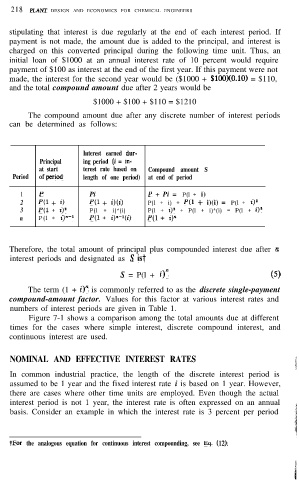
        The compound amount due after any discrete number of interest periods
   can be determined as follows:


                      Interest earned  dur-
           Principal  ing period (i  = in-
           at start   terest rate based on  Compound amount S
    Period  of period  length of one period)  at end of period
      1    P            Pi             P  + Pi = P(l +  i)
      2    PC1  + i)    PC1  + i)(i)   P(l + i) +  P(1  +  i)(i) = P(l + i)*
      3    P(1  + $2    P(l + i)*(i)   P(l +  i)*  + P(l + i)*(i) = P(l +  i)’
      n    P(l +  ip--l  P(1  + +-l(i)  P(1  + i)”


   Therefore, the total amount of principal plus compounded interest due after n
    interest periods and designated as S  isi’

                                s  = P(l + i)”                        (5)

        The term (1 + i)” is commonly referred to as the  discrete single-payment
   compound-amount factor. Values for this factor at various interest rates and
    numbers of interest periods are given in Table 1.
        Figure 7-1 shows a comparison among the total amounts due at different
    times for the cases where simple interest, discrete compound interest, and
   continuous interest are used.

    NOMINAL AND EFFECTIVE INTEREST RATES
                                                                             d
    In common industrial practice, the length of the discrete interest period is
    assumed to be 1 year and the fixed interest rate i is based on 1 year. However,
    there are cases where other time units are employed. Even though the actual
    interest period is not 1 year, the interest rate is often expressed on an annual
    basis. Consider an example in which the interest rate is 3 percent per period


    tFor  the analogous equation for continuous interest compounding, see  Q.   (12).

