


Page 250 - Plant design and economics for chemical engineers
P. 250
220  PLANT DESIGN AND ECONOMICS FOR CHEMICAL ENGINEERS


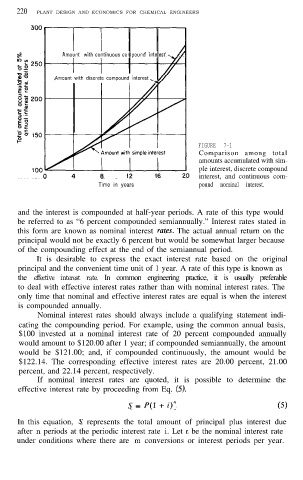
                 Amount with continuous compound interest


               Amount with discrete compound interest


                                                    FIGURE 7-1
                                                    Comparison among total
                                                    amounts accumulated with sim-
                                                    ple interest, discrete compound
                                                    interest, and continuous com-
                          Time in years             pound nominal interest.


      and the interest is compounded at half-year periods. A rate of this type would
     be referred to as “6 percent compounded semiannually.” Interest rates stated in
     this form are known as nominal interest rates.  The actual annual return on the
      principal would not be exactly 6 percent but would be somewhat larger because
      of the compounding effect at the end of the semiannual period.
          It is desirable to express the exact interest rate based on the original
      principal and the convenient time unit of 1 year. A rate of this type is known as
      the  effective interest rate.  In common engineering practice, it is usually preferable
      to deal with effective interest rates rather than with nominal interest rates. The
      only time that nominal and effective interest rates are equal is when the interest
      is compounded annually.
           Nominal interest rates should always include a qualifying statement indi-
      cating the compounding period. For example, using the common annual basis,
      $100 invested at a nominal interest rate of 20 percent compounded annually
      would amount to $120.00 after 1 year; if compounded semiannually, the amount
      would be $121.00; and, if compounded continuously, the amount would be
      $122.14. The corresponding effective interest rates are 20.00 percent, 21.00
      percent, and 22.14 percent, respectively.
           If nominal interest rates are quoted, it is possible to determine the
      effective interest rate by proceeding from Eq. (5).
                                  s = P(1  + i)”

     In this equation, S  represents the total amount of principal plus interest due
     after  n periods at the periodic interest rate i. Let  r  be the nominal interest rate
     under conditions where there are m  conversions or interest periods per year.

