


Page 252 - Plant design and economics for chemical engineers
P. 252
222  PLANT DESIGN AND ECONOMICS FOR CHEMICAL ENGINEERS

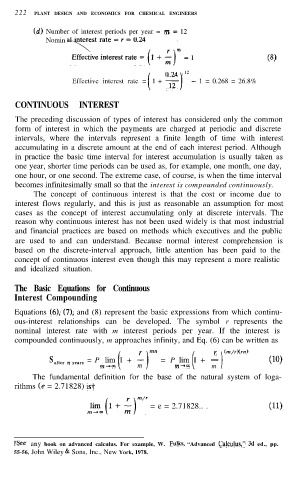
          (d)  Number of interest periods per year = m  =  12
             Nomin
                                               m
                                                - 1                   (8)
                                       (  02,)   1 2
                    Effective interest rate = 1 +  12  -  1 = 0.268 = 26.8%


     CONTINUOUS      INTEREST
     The preceding discussion of types of interest has considered only the common
     form of interest in which the payments are charged at periodic and discrete
     intervals, where the intervals represent a finite length of time with interest
     accumulating in a discrete amount at the end of each interest period. Although
     in practice the basic time interval for interest accumulation is usually taken as
     one year, shorter time periods can be used as, for example, one month, one day,
     one hour, or one second. The extreme case, of course, is when the time interval
     becomes infinitesimally small so that the interest is compounded continuously.
          The concept of continuous interest is that the cost or income due to
     interest flows regularly, and this is just as reasonable an assumption for most
     cases as the concept of interest accumulating only at discrete intervals. The
     reason why continuous interest has not been used widely is that most industrial
     and financial practices are based on methods which executives and the public
     are used to and can understand. Because normal interest comprehension is
     based on the discrete-interval approach, little attention has been paid to the
     concept of continuous interest even though this may represent a more realistic
     and idealized situation.

     The Basic Equations for Continuous
     Interest Compounding
     Equations  (6), (7),  and (8) represent the basic expressions from which continu-
     ous-interest relationships can be developed. The symbol  r  represents the
     nominal interest rate with  m  interest periods per year. If the interest is
     compounded continuously, m approaches infinity, and Eq. (6) can be written as
                                        mn              r   (m/rXm)
              S after  n  years  = P lim 1 + L  1  =  P  lim 1 + -  1  (10)
                           m-+m
                                    m
                                              m-m
                                                       m
                                                   (
                               (
         The fundamental definition for the base of the natural system of loga-
     rithms (e = 2.71828) is?
                                        = e = 2.71828.. .             (11)


     tsee  any  book on advanced calculus. For example, W. Fulks,  “Advanced Calculus,”   3d  ed., pp.
     55-56, John Wiley & Sons, Inc., New York, 1978.

