


Page 253 - Plant design and economics for chemical engineers
P. 253
INTEREST AND INVESTMENT COSTS 223

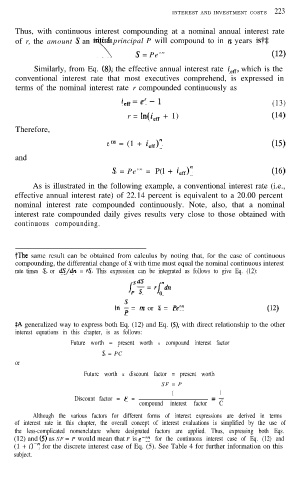
     Thus, with continuous interest compounding at a nominal annual interest rate
     of  r, the  amount S an ’  ‘tial  principal P will compound to in n  years is?+
                         7          S = Pe’”                          (12)
          Similarly, from Eq. (8),  the effective annual interest rate ieff,  which is the
     conventional interest rate that most executives comprehend, is expressed in
     terms of the nominal interest rate r compounded continuously as

                                ’   =e’-1                             (13)
                                leff
                                  r =  In(i,,  + 1)                   (14)
     Therefore,
                            e ‘n  = (1 + ieff)”                       (15)
     and

                              S  = Pe’” = P(l + i,ff)n                (16)
         As is illustrated in the following example, a conventional interest rate (i.e.,
     effective annual interest rate) of 22.14 percent is equivalent to a 20.00 percent
     nominal interest rate compounded continuously. Note, also, that a nominal
     interest rate compounded daily gives results very close to those obtained with
     continuous compounding.


     tThe  same result can be obtained from calculus by noting that, for the case of continuous
     compounding, the differential change of S with time must equal the nominal continuous interest
     rate times S,  or dS/dn   =  KS.  This expression can be integrated as follows to give Eq. (12):

                                  ,,5; =  rpn

                              In  f =  m  or S =  Pern               (12)

     $A generalized way to express both Eq. (12) and Eq.  (9, with direct relationship to the other
     interest equations in this chapter, is as follows:
                   Future worth = present worth  x  compound interest factor
                           s  = PC
     or
                      Future worth  x  discount factor = present worth
                                          SF = P
                                             1           1
                    Discount factor =  F  =            c-...
                                     compound  interest  factor  C
         Although the various factors for different forms of interest expressions are derived in terms
     of interest rate in this chapter, the overall concept of interest evaluations is simplified by the use of
     the less-complicated nomenclature where designated factors are applied. Thus, expressing both Eqs.
     (12) and (5) as SF = P would mean that F is e-‘” for the continuous interest case of Eq. (12) and
     (1 +  i)-”  for the discrete interest case of Eq. (5). See Table 4 for further information on this
     subject.

