


Page 261 - Plant design and economics for chemical engineers
P. 261
INTEREST  AND  INVESTMENT  COSTS  2 3 1

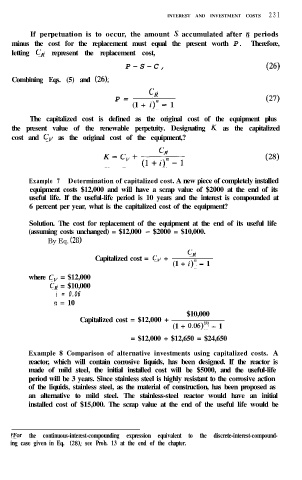
         If perpetuation is to occur, the amount S  accumulated after II  periods
    minus the cost for the replacement must equal the present worth  P.  Therefore,
    letting  CR  represent the replacement cost,
                                 P - S - C ,                          (26)
    Combining Eqs. (5) and  (26),
                                       CR
                               P =
                                   (1 + i)”  -  1
         The capitalized cost is defined as the original cost of the equipment plus
    the present value of the renewable perpetuity. Designating  K  as the capitalized
    cost and  C,  as the original cost of the equipment,?
                                          cl?
                            K=G+(1+i)n


         Example 7  Determination of capitalized cost. A new piece of completely installed
         equipment costs $12,000 and will have a scrap value of $2000 at the end of its
         useful life. If the useful-life period is 10 years and the interest is compounded at
         6 percent per year, what is the capitalized cost of the equipment?

         Solution. The cost for replacement of the equipment at the end of its useful life
        (assuming costs unchanged) = $12,000 -  $2000 = $10,000.
             By Eq. (28)
                                                 CR
                         Capitalized cost = C,  +
                                             (1 +  i)” -  1
        where  Cy  = $12,000
              c,  = $10,000
               i  = 0.06
               n  = 10
                                                 $10,000
                      Capitalized cost = $12,000 +
                                             (1 +  o.06)‘0  -  1
                                   = $12,000 + $12,650 = $24,650
        Example 8 Comparison of alternative investments using capitalized costs. A
        reactor, which will contain corrosive liquids, has been designed. If the reactor is
        made of mild steel, the initial installed cost will be $5000, and the useful-life
        period will be 3 years. Since stainless steel is highly resistant to the corrosive action
        of the liquids, stainless steel, as the material of construction, has been proposed as
        an alternative to mild steel. The stainless-steel reactor would have an initial
        installed cost of $15,000. The scrap value at the end of the useful life would be


    tFor  the continuous-interest-compounding expression equivalent to the discrete-interest-compound-
    ing case given in Eq. (28),  see Prob. 13 at the end of the chapter.

