


Page 262 - Plant design and economics for chemical engineers
P. 262
232  PLANT DESIGN AND ECONOMICS FOR CHEMICAL ENGINEERS
            zero for either type of reactor, and both could be replaced at a cost equal to the
            original price. On the basis of equal capitalized costs for both types of reactors,
            what should be the useful-life period for the stainless-steel reactor if money is
            worth 6 percent compounded annually?

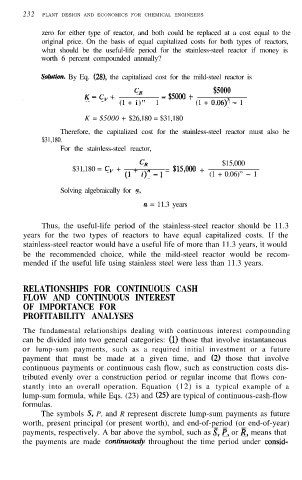
            Sdution.  By Eq. (28),  the capitalized cost for the mild-steel reactor is
                                    CR                  $5000
                       K=C,+
                                (1 + i)” - 1 = SsOOO   +  (1 + 0.06Q -  1
                       K = $5000 + $26,180 = $31,180
                 Therefore, the capitalized cost for the stainless-steel reactor must also be
            $31,180.
                 For the stainless-steel reactor,
                                     CR                   $15,000
                    $31,180 =  c,  + (1 +  i)”  _ 1 =  $15,~  +
                                                       (1 + 0.06)” -  1

                 Solving algebraically for n,
                                      II  = 11.3 years


            Thus, the useful-life period of the stainless-steel reactor should be 11.3
       years for the two types of reactors to have equal capitalized costs. If the
       stainless-steel reactor would have a useful life of more than 11.3 years, it would
       be the recommended choice, while the mild-steel reactor would be recom-
       mended if the useful life using stainless steel were less than 11.3 years.


       RELATIONSHIPS FOR CONTINUOUS CASH
       FLOW AND CONTINUOUS INTEREST
       OF IMPORTANCE FOR
       PROFITABILITY ANALYSES
       The fundamental relationships dealing with continuous interest compounding
       can be divided into two general categories: (1)  those that involve instantaneous
       or  lump-sum payments, such as a required initial investment or a future
       payment that must be made at a given time, and  (2)  those that involve
       continuous payments or continuous cash flow, such as construction costs dis-
       tributed evenly over a construction period or regular income that flows con-
       stantly into an overall operation. Equation (12) is a typical example of a
       lump-sum formula, while Eqs. (23) and (25) are typical of continuous-cash-flow
       formulas.
            The symbols S, P, and R represent discrete lump-sum payments as future
       worth, present principal (or present worth), and end-of-period (or end-of-year)
       payments, respectively. A bar above the symbol, such as 5, P, or E, means that
       the payments are made continuou.$y   throughout the time period under consid-

