


Page 268 - Plant design and economics for chemical engineers
P. 268
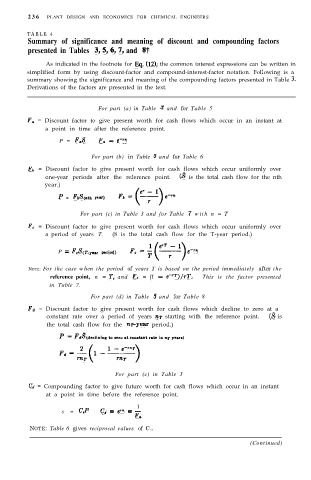
2 3 6  PLANT DESIGN AND ECONOMICS FOR CHEMICAL ENGINEERS

        TABLE  4
        Summary of significance and meaning of discount and compounding factors
        presented in Tables 3,5,6,7,  and  8t

             As indicated in the footnote for Eq.  (12),  the common interest expressions can be written in
        simplified form by using discount-factor and compound-interest-factor notation. Following is a
        summary showing the significance and meaning of the compounding factors presented in Table 3.
        Derivations of the factors are presented in the text.

                          For part (a) in Table 3  and for  Table 5
        F,  = Discount factor to give present worth for cash flows which occur in an instant at
             a point in time after the reference point.
                P =  F.S   ji’.   =  e-r*

                         For part (b) in  Table  3 and  for  Table 6
        Fb   = Discount factor to give present worth for cash flows which occur uniformly over
             one-year periods after the reference point.  (8  is the total cash flow for the nth
             year.)
                P  = Fb&th   yeul

                      For part (c) in Table 3 and for Table 7  with n = T
        F,  = Discount factor to give present worth for cash flows which occur uniformly over
             a period of years T.  (8 is the total cash flow for the T-year period.)

                P  =  FS(~-~esr wrid)            e-‘”

        NOTE:  For the case when the period of  years T is based on the period immediately after the
              reference point, n =  T,  and F.  =  (1  -  eerT)/rT.  This is the factor presented
              in Table 7.
                        For part (d) in Table 3 and  for  Table 8
        Fd   = Discount factor to give present worth for cash flows which decline to zero at a
             constant rate over a period of years  nT   starting with the reference point.  (S  is
             the total cash flow for the nr-year  period.)


                               For part (e) in Table 3
         C.  = Compounding factor to give future worth for cash flows which occur in an instant
             at a point in time before the reference point.
                                    1
                 s  =  C.P  c,  i  .p   P  -
                                    F.
         NOTE:  Table 6 gives  reciprocal values  of  C..

                                                                 (Continued)

