


Page 269 - Plant design and economics for chemical engineers
P. 269
INTEREST AND INVESTMENT COSTS 237

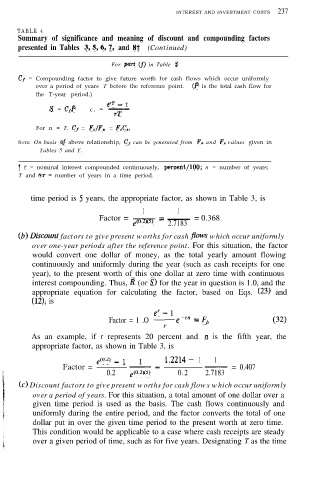
     TABLE  4
      Summary of significance and meaning of discount and compounding factors
      presented in Tables 3,5,6,7,  and  St  (Continued)

                              For  part   (f)  in Table 3
      Cl  = Compounding factor to give future worth for cash flows which occur uniformly
          over a period of years T  before the reference point.  (P  is the total cash flow for
          the T-year period.)
                             erT  -  1
              s  =  cg  c ,  =  ~
                              rT
          For n =  T,  C,  = F,/F.  =  F,C,.
      NOTE:  On basis  of  above relationship, C,  can be generated from F,  and  F, values  given in
           Tables 5 and Y.
      t  r  = nominal interest compounded continuously, percent/loo;    n  = number of years;
      T  and  nT   = number of years in a time period.

         time period is 5  years, the appropriate factor, as shown in Table 3, is
                                      1        1
                           Factor = -   =  ~ = 0.368
                                   &QX5)
                                            2.7183
      (b) Dkcount factors to give present worths for cash flows  which occur uniformly
         over one-year periods after the reference point. For this situation, the factor
         would convert one dollar of money, as the total yearly amount flowing
         continuously and uniformly during the year (such as cash receipts for one
         year), to the present worth of this one dollar at zero time with continuous
         interest compounding. Thus, i? (or 3) for the year in question is 1.0, and the
         appropriate equation for calculating the factor, based on Eqs.  (23)  and
         (12),  is
                                         e’ - 1
                             Factor = 1 .O -e   -m  _                  (32)
                                                   - Fb
                                           r
         As an example, if r represents 20 percent and n  is the fifth year, the
         appropriate factor, as shown in Table 3, is

                          ew  - 1    1     1.2214- 1    1
                 Factor =         -   =               ~ = 0.407
                            0.2   ewx5)        0.2    2.7183
      (c) Discount factors to give present worths for cash flows which occur uniformly
         over a period of years. For this situation, a total amount of one dollar over a
         given time period is used as the basis. The cash flows continuously and
         uniformly during the entire period, and the factor converts the total of one
         dollar put in over the given time period to the present worth at zero time.
         This condition would be applicable to a case where cash receipts are steady
         over a given period of time, such as for five years. Designating T as the time

