


Page 270 - Plant design and economics for chemical engineers
P. 270
238  PLANT DESIGN AND ECONOMICS FOR CHEMICAL ENGINEERS

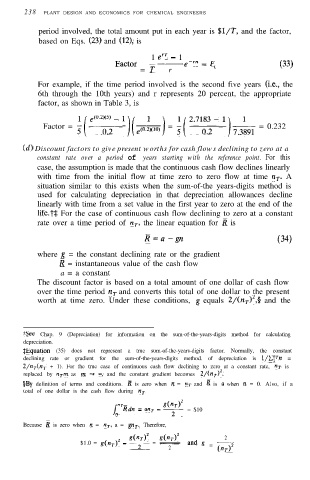
           period involved, the total amount put in each year is $l/T,  and the factor,
           based on Eqs. (23) and  (12),  is
                                        1 erT -  1
                                         -e-m   =  j7
                               Factor  = r  r           c                (33)

           For example, if the time period involved is the second five years (i.e.,  the
           6th through the 10th years) and r represents 20 percent, the appropriate
           factor, as shown in Table 3, is


            Factor = i(  e’“‘2~~~-  ‘)(A)   = $(  2*71tg:-   I)&    = 0.232

       Cd) Discount factors to give present worths for cash flows declining to zero at a
           constant rate over a period  of  years starting with the reference point.  For this
           case, the assumption is made that the continuous cash flow declines linearly
           with time from the initial flow at time zero to zero flow at time  r+  A
           situation similar to this exists when the sum-of-the years-digits method is
           used for calculating depreciation in that depreciation allowances decline
           linearly with time from a set value in the first year to zero at the end of the
           life.t$  For the case of continuous cash flow declining to zero at a constant
           rate over a time period of n,,  the linear equation for R  is

                                      R=a-gn                            (34)
           where  g  = the constant declining rate or the gradient
                R  = instantaneous value of the cash flow
                 a = a constant
           The discount factor is based on a total amount of one dollar of cash flow
           over the time period nT and converts this total of one dollar to the present
           worth at time zero. Under these conditions, g  equals 2/(nT)*,§   and the


       tSee  Chap. 9 (Depreciation) for information on the sum-of-the-years-digits method for calculating
       depreciation.
       SEquation  (35)  does  not  represent  a  true  sum-of-the-years-digits  factor.  Normally,  the  constant
       declining rate  or  gradient  for  the  sum-of-the-years-digits  method.  of  depreciation  is  l/C?Tn  =
       2/n,(n,  + 1). For the true case of continuous cash flow declining to zero at a constant rate, nr  is
       replaced by  nrm  as m  -+  m,  and the constant gradient becomes  2/(nr)‘.
       IBv _  definition of terms and conditions. R  is zero when n  = nr  and R  is n  when n  = 0. Also, if a
       -
       total of one dollar is the cash flow during nr
                              pn  =  anT  -  !y  = $10
                               0
       Because  E  is zero when n  = nr,  a = gn,.  Therefore,
                                  gw*     dnT)*            2
                      $1.0 = g(Q)2   -  2  = -   and   g  =  (“r)i
                                            2

