


Page 331 - Plastics Engineering
P. 331
3 14                                            Processing of Plastics
                        early machines did not have sufficient accuracy or control over such things as
                        cylinder temperature and the gap between the rolls. Therefore acceptance of the
                        technique as a viable production method was slow until the 1930s when special
                        equipment was developed specifically for the new plastic materials. As well as
                        being able to maintain accurately roll temperature in the region of 200°C these
                        new machines had power assisted nip adjustment and the facility to adjust the
                        rotational speed of  each roll independently. These developments are still the
                        main features of modem calendering equipment.
                          Calenders vary  in  respect of  the number of  rolls  and  of  the  arrangement
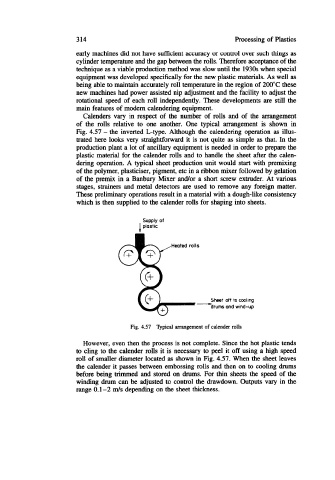
                        of  the  rolls  relative  to  one  another.  One  typical  arrangement  is  shown  in
                        Fig. 4.57 - the inverted L-type. Although the calendering operation as illus-
                        trated here looks very straightforward it is not quite as simple as that. In the
                        production plant a lot of ancillary equipment is needed in order to prepare the
                        plastic material for the calender rolls and to handle the sheet after the calen-
                        dering operation. A typical sheet production unit would start with premixing
                        of the polymer, plasticiser, pigment, etc in a ribbon mixer followed by gelation
                        of  the premix in a Banbury Mixer and/or a short screw extruder. At various
                        stages, strainers and metal detectors are used to remove any foreign matter.
                        These preliminary operations result in a material with a dough-like consistency
                        which is then supplied to the calender rolls for shaping into sheets.


                                            Supply  of
                                           1 plastic


                                                               -
                                                                 Sheet off to cooling
                                                                 drums and wind-up
                                                                     I

                                        Fig. 4.57  'Qpical arrangement of  calender rolls

                          However, even then the process is not complete. Since the hot plastic tends
                        to cling to the calender rolls it is necessary to peel it off  using a high speed
                        roll of  smaller diameter located as shown in Fig. 4.57. When the sheet leaves
                        the calender it passes between embossing rolls and then on to cooling drums
                        before being trimmed and stored on drums. For thin  sheets the speed of  the
                        winding drum can be adjusted to control the drawdown. Outputs vary in the
                        range 0.1-2  m/s  depending on the sheet thickness.

