


Page 326 - Plastics Engineering
P. 326
Processing of Plastics                                         309

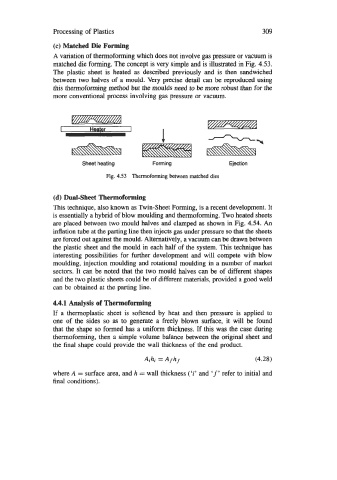
                 (c) Matched Die Forming
                 A variation of thermoforming which does not involve gas pressure or vacuum is
                 matched die forming. The concept is very simple and is illustrated in Fig. 4.53.
                 The plastic  sheet  is  heated  as described previously and  is  then  sandwiched
                 between two halves of  a mould. Very  precise detail can be reproduced using
                 this thermoforming method but the moulds need to be more robust than for the
                 more conventional process involving gas pressure or vacuum.


                          Sheet heating        Forming                Ejection

                                 Fig. 4.53  Thermofonning between matched dies

                 (d) Dual-Sheet Thennoforming
                 This technique, also known as Twin-Sheet Forming, is a recent development. It
                 is essentially a hybrid of blow moulding and thermofonning.  Two heated sheets
                 are placed between two mould halves and clamped as shown in Fig. 4.54. An
                 inflation tube at the parting line then injects gas under pressure so that the sheets
                 are forced out against the mould. Alternatively, a vacuum can be drawn between
                 the plastic sheet and the mould in each half of the system. This technique has
                 interesting possibilities for further development and will compete with blow
                 moulding, injection moulding and rotational moulding in a number of  market
                 sectors. It can be noted that the two mould halves can be of  different shapes
                 and the two plastic sheets could be of different materials, provided a good weld
                 can be obtained at the parting line.
                 4.4.1 Analysis of Thennoforming
                 If  a  thermoplastic sheet is  softened by  heat  and  then  pressure is  applied to
                 one of  the  sides so  as  to  generate a  freely blown  surface, it  will  be  found
                 that the shape so formed has a uniform thickness. If  this was the case during
                 thermoforming, then a simple volume balance between the original sheet and
                 the final shape could provide the wall thickness of  the end product.

                                             Aihi  = Afhf                     (4.28)

                 where A = surface area, and h = wall thickness (‘i’  and ‘f’ refer to initial and
                 final conditions).

