


Page 329 - Plastics Engineering
P. 329
312                                             Processing of Plastics
                        be estimated by  assuming that the volume remains constant.

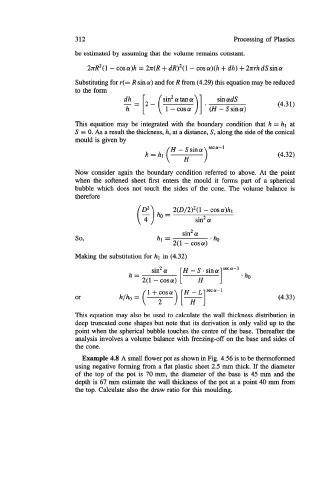
                           2nR2( 1 - cos a)h = 2n(R + dR)2( 1 - cos a)(h + dh) + 2xrh dS sin a

                        Substituting for r(= R sina) and for R from (4.29) this equation may be reduced
                        to the form
                                                  sin2  a tan a    sin ads
                                       h           1 - cosa     (H - S sina)         (4.31)

                        This equation may  be integrated with the boundary condition that h = hl  at
                        S = 0. As a result the thickness, h, at a distance, S, along the side of the conical
                        mould is given by
                                                               )
                                                     H - s sina  seca-l
                                             h=h1(                                   (4.32)

                        Now  consider again the boundary condition referred to  above. At  the point
                        when  the  softened sheet first  enters the  mould  it  forms part  of  a  spherical
                        bubble which does not touch the  sides of  the  cone. The volume balance is
                        therefore

                                                     2(0/2)2( 1 - cos a)h1
                                                            sin2 a
                                                        sin2 a
                        so.                     hi  =            *h
                                                     2( 1 - cos a)
                        Making the substitution for hl  in (4.32)


                                        h=
                                            2(  1 - cos a)
                                              1 +cosa    H --L
                        or                                                           (4.33)
                                     hlh=(  2  )[XI
                        This equation may also be used to calculate the wall thickness distribution in
                        deep truncated cone shapes but note that its derivation is only valid up to the
                        point when the spherical bubble touches the centre of the base. Thereafter the
                        analysis involves a volume balance with freezing-off on the base and sides of
                        the cone.

                          Example 4.8  A small flower pot as shown in Fig. 4.56 is to be thermoformed
                        using negative forming from a flat plastic sheet 2.5 mm thick. If  the diameter
                        of  the top of  the pot is 70 mm,  the diameter of  the base is 45 mm  and the
                        depth is 67 mm estimate the wall thickness of the pot at a point 40 mm from
                        the top. Calculate also the draw ratio for this moulding.

