


Page 325 - Plastics Engineering
P. 325
308                                             pn>cessing of Plastics

                        is easily shaped, has good thermal conductivity, can be highly polished and
                        has an almost unlimited life.
                          Materials which can be  vacuum formed satisfactorily include polystyrene,
                        ABS, PVC, acrylic, polycarbonate, polypropylene and high and low density
                        polyethylene. Co-extruded sheets of  different plastics and multi-colour lami-
                        nates are also widely used nowadays. One of  the most recent developments is
                        the thennoforming of crystallisable PET for high temperature applications such
                        as oven trays. The PET sheet is manufactured in the amorphous form and then
                        during thennoforming it is permitted to crystallise. The resulting moulding is
                        thus capable of remaining stiff at elevated temperatures.

                        (b) Pressure Forming
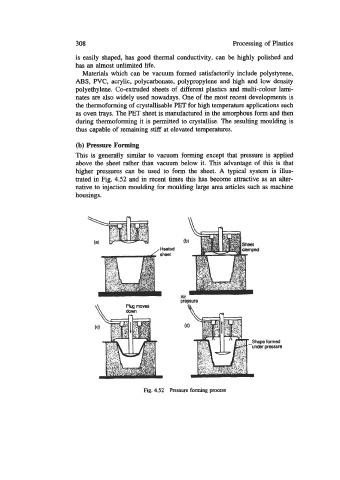
                        This is generally similar to vacuum forming except that pressure is applied
                        above the sheet rather than  vacuum below  it. This advantage of  this  is that
                        higher  pressures can  be  used  to form the  sheet.  A  typical  system is  illus-
                        trated in Fig. 4.52 and in recent times this has become attractive as an alter-
                        native to injection moulding for moulding large area articles such as machine
                        housings.


                                                        * ...

                                       Plug moves


                                             Fig. 4.52

