


Page 320 - Plastics Engineering
P. 320
Processing of Plastics                                         303

                 area mouldings  such as car bumpers  and body  panels.  Another consequence
                 of  the  low  injection  pressures  is  that  mould  materials  other  than  steel  may
                 be considered. Aluminium has been used successfully and this permits weight
                 savings in large moulds. Moulds are also less expensive than injection moulds
                 but  they  must  not be regarded  as cheap. RIM moulds require careful design
                 and, in particular, a good surface finish because the expansion of the material
                 in  the mould during polymerisation causes every detail on the surface of  the
                 mould to be reproduced on the moulding.


                 4.3.9  Injection Blow Moulding
                 In Section 4.2.7 we considered the process of  extrusion blow moulding which
                 is used to produce hollow articles such as bottles. At that time it was mentioned
                 that if  molecular orientation can be introduced to the moulding then the prop-
                 erties are significantly improved. In recent years the process of injection blow
                 moulding has been developed to achieve this objective. It is now very widely
                 used for the manufacture of  bottles for soft drinks.
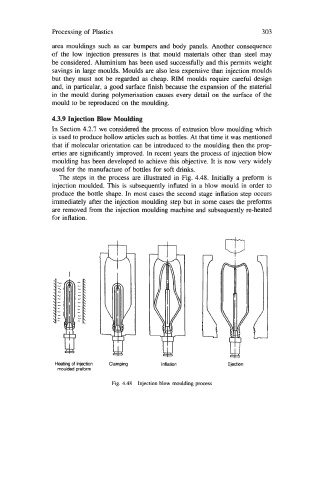
                   The  steps in  the process  are illustrated  in  Fig. 4.48. Initially  a preform  is
                 injection moulded. This is subsequently inflated in a blow mould in order to
                 produce the bottle shape. In most cases the second stage inflation step occurs
                 immediately after the injection moulding step but in some cases the preforms
                 are removed from the injection moulding machine and subsequently re-heated
                 for inflation.


                                                                             .i


                      I


                 Heating of injection   Clamping   Inflation          Ejection
                  moulded preform

                                   Fig. 4.48  Injection blow moulding process

