


Page 321 - Plastics Engineering
P. 321
304                                             Processing of Plastics
                          The advantages of injection blow moulding are that
                            (i)  the  injection  moulded parison  may  have  a  carefully controlled  wall
                               thickness profile to ensure a uniform wall thickness in the inflated bottle.
                           (ii)  it is possible to have intricate detail in the bottle neck.
                          (iii) there is no trimming or flash (compare with extrusion blow moulding).
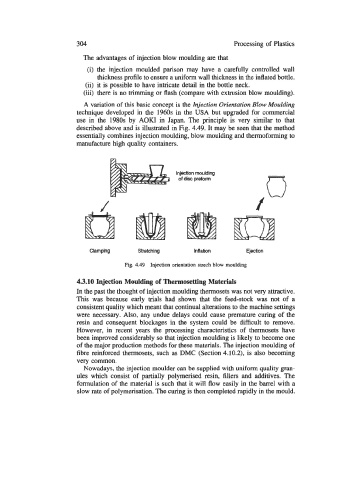
                          A variation of this basic concept is the Injection Orientation Blow Moulding
                        technique developed in  the  1960s in  the USA  but  upgraded for commercial
                        use  in  the  1980s by  AOKI  in  Japan.  The  principle  is  very  similar to  that
                        described above and is illustrated in Fig. 4.49. It may be seen that the method
                        essentially combines injection moulding, blow moulding and thermoforming to
                        manufacture high quality containers.


                                                       Injection moulding
                                                       of disc preform            U


                                                                               f


                            Clamping       Stretching       Inflation       Ejection

                                       Fig. 4.49  Injection orientation strech blow moulding
                        4.3.10 Injection Moulding of Thermosetting Materials
                        In the past the thought of injection moulding thermosets was not very attractive.
                        This  was  because  early  trials  had  shown that  the  feed-stock  was  not  of  a
                        consistent quality which meant that continual alterations to the machine settings
                        were necessary. Also, any undue delays could cause premature curing of  the
                        resin  and consequent blockages in  the  system could be  difficult to  remove.
                        However, in  recent  years  the  processing characteristics  of  thermosets have
                        been improved considerably so that injection moulding is likely to become one
                        of the major production methods for these materials. The injection moulding of
                        fibre reinforced thennosets, such as DMC (Section 4.10.2), is also becoming
                        very common.
                          Nowadays, the injection moulder can be supplied with uniform quality gran-
                        ules  which  consist of  partially  polymerised resin, fillers and  additives. The
                        formulation of  the material is such that it will flow easily in the barrel with a
                        slow rate of polymerisation. The curing is then completed rapidly in the mould.

