


Page 324 - Plastics Engineering
P. 324
Processing of Plastics                                          307

                             Heater                 Plastic sheet


              Vents


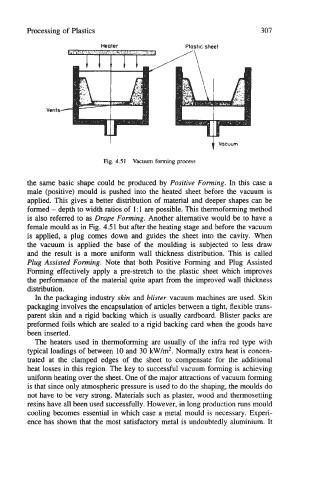
                             Fig. 4.51  Vacuum forming process

        the same basic shape could be produced by  Positive Forming. In this case a
        male (positive) mould is pushed  into the heated  sheet before the vacuum is
        applied. This gives a better distribution of material and deeper shapes can be
        formed - depth to width ratios of  1 : 1 are possible. This thermoforming method
        is also referred to as Drupe Forming. Another alternative would be to have a
        female mould as in Fig. 4.5 1 but after the heating stage and before the vacuum
        is applied, a  plug  comes down  and  guides the  sheet into the cavity.  When
        the  vacuum  is  applied the  base  of  the  moulding  is  subjected  to  less  draw
        and  the result  is  a  more  uniform  wall  thickness distribution. This  is  called
        Plug Assisted Forming.  Note  that  both  Positive Forming  and  Plug Assisted
        Forming  effectively apply  a  pre-stretch  to  the plastic sheet which  improves
        the performance of  the material quite apart from the improved wall thickness
        distribution.
           In the packaging industry skin  and blister vacuum machines are used. Skin
        packaging involves the encapsulation of articles between a tight, flexible trans-
        parent skin and a rigid backing which is usually cardboard. Blister packs are
        preformed foils which are sealed to a rigid backing card when the goods have
        been inserted.
           The heaters used  in  thermoforming are usually of  the infra red  type with
        typical loadings of between  10 and 30 kW/m2. Normally extra heat is concen-
        trated  at  the  clamped edges  of  the  sheet  to  compensate for  the  additional
        heat losses in this region. The key to successful vacuum forming is achieving
        uniform heating over the sheet. One of the major attractions of vacuum forming
        is that since only atmospheric pressure is used to do the shaping, the moulds do
        not have to be very strong. Materials such as plaster, wood and thermosetting
        resins have all been used successfully. However, in long production runs mould
        cooling becomes essential in which case a metal mould is necessary. Experi-
         ence has shown that the most satisfactory metal is undoubtedly aluminium. It

