


Page 323 - Plastics Engineering
P. 323
306                                             Processing of Plastics

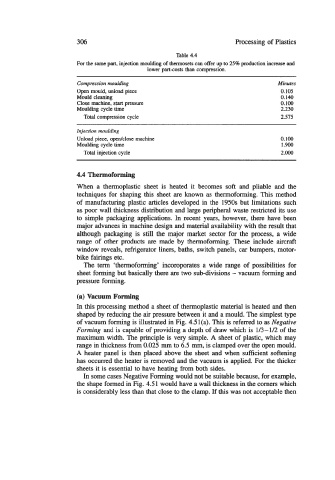
                                                      Table 4.4
                        For the same part, injection moulding of thermosets can offer up to 25% production increase and
                                             lower part-costs than compression.

                        Compression moulding                                         Minutes
                        Open mould, unload piece                                      0.105
                        Mould cleaning                                                0.140
                        Close machine, start pressure                                 0.100
                        Moulding cycle time                                           2.230
                          Total compression cycle                                     2.575

                        Injection moulding
                        Unload piece, opedclose machine                               0.100
                        Moulding cycle time                                           1 .goo
                          Total injection cycle                                       2.000


                        4.4  Thennoforming
                        When  a  thermoplastic sheet is  heated  it  becomes  soft  and  pliable  and  the
                        techniques for shaping this sheet are known as thermoforming. This method
                        of  manufacturing plastic articles developed in the  1950s but limitations such
                        as poor wall thickness distribution and large peripheral waste restricted its use
                        to  simple packaging applications. In recent years, however, there have been
                        major advances in machine design and material availability with the result that
                        although packaging is  still the major market  sector for the process,  a  wide
                        range  of  other products are made  by  thermoforming. These include aircraft
                        window reveals, refrigerator liners, baths, switch panels, car bumpers, motor-
                        bike fairings etc.
                          The term  ‘thermoforming’ incoroporates a  wide range of  possibilities for
                        sheet forming but basically there are two sub-divisions - vacuum forming and
                        pressure forming.

                        (a) Vacuum Forming
                        In this processing method a sheet of thermoplastic material is heated and then
                        shaped by reducing the air pressure between it and a mould. The simplest type
                        of vacuum forming is illustrated in Fig. 4.5 l(a). This is referred to as Negative
                        Forming and is capable of providing a depth of draw which is 113-112  of the
                        maximum width. The principle is very simple. A sheet of  plastic, which may
                        range in thickness from 0.025 mm to 6.5 mm, is clamped over the open mould.
                        A heater panel is then placed above the sheet and when  sufficient softening
                        has occurred the heater is removed and the vacuum is applied. For the thicker
                        sheets it is essential to have heating from both sides.
                          In some cases Negative Forming would not be suitable because, for example,
                        the shape formed in Fig. 4.5 1 would have a wall thickness in the comers which
                        is considerably less than that close to the clamp. If this was not acceptable then

