


Page 322 - Plastics Engineering
P. 322
Processing of  Plastics                                        305

                  In most respects the process is similar to the injection moulding of  thermo-
                  plastics and the sequence of  operations in a single cycle is as described earlier.
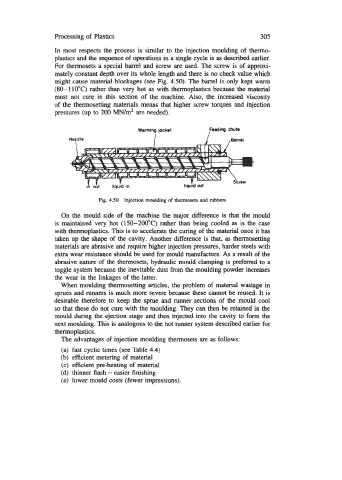
                  For thermosets a special barrel and screw are used. The screw is of  approxi-
                  mately constant depth over its whole length and there is no check value which
                  might cause material blockages (see Fig. 4.50). The barrel is only kept warm
                  (80-110°C)  rather than very hot as with thermoplastics because the material
                  must  not  cure  in  this  section of  the  machine.  Also,  the increased viscosity
                  of  the thermosetting materials means that higher screw torques and injection
                  pressures (up to 200 MN/m2 are needed).

                                           Warming jacket
                      Nafzle                    I


                               Fig. 4.50  Injection modding of thermosets and rubbers

                    On the mould  side of  the machine the major difference is that the mould
                  is maintained very hot  (150-200°C)  rather than being cooled as is the case
                  with thermoplastics. This is to accelerate the curing of the material once it has
                  taken up the shape of  the cavity. Another difference is that, as thermosetting
                  materials are abrasive and require higher injection pressures, harder steels with
                  extra wear resistance should be used for mould manufacture. As a result of the
                  abrasive nature of  the thermosets, hydraulic mould clamping is preferred to a
                  toggle system because the inevitable dust from the moulding powder increases
                  the wear in the linkages of  the latter.
                    When moulding thermosetting articles, the problem of  material wastage in
                  sprues and runners is much more severe because these cannot be reused. It is
                  desirable therefore to keep the sprue and runner sections of  the mould cool
                  so that these do not cure with the moulding. They can then be retained in the
                  mould during the ejection stage and then injected into the cavity to form the
                  next moulding. This is analogous to the hot runner system described earlier for
                  thermoplastics.
                    The advantages of  injection moulding thermosets are as follows:
                    (a)  fast cyclic times (see Table 4.4)
                    (b)  efficient metering of  material
                    (c) efficient pre-heating of  material
                    (d) thinner flash - easier finishing
                    (e) lower mould costs (fewer impressions).

