


Page 336 - Plastics Engineering
P. 336
Processing of  Plastics                                         319
                 independent so that if cooling is completed then that arm can leave the cooling
                 bay whilst the other arms remain in position.
                   It is important to realise that rotational moulding is not a centrifugal casting
                 technique. The rotational speeds are generally below 20 rev/min with the ratio
                 of speeds about the major and minor axes being typically 4 to 1. Also since all
                 mould surfaces are not equidistant from the centre of rotation any centrifugal
                 forces generated would tend to cause large variations in wall thickness. In fact
                 in order to ensure uniformity of  all thickness it is normal design practice to
                 arrange that  the  point  of  intersection of  the  major and  minor  axis does  not
                 coincide with the centroid of  the mould.
                   The heating of rotational moulds may be achieved using infra-red, hot liquid,
                 open gas flame or hot-air convection. However, the latter method is the most
                 common. The oven temperature is usually in the range 250-450°C  and since
                 the mould is cool when it enters the oven it takes a certain time to get up to a
                 temperature which will melt the plastic. This time may be estimated as follows.
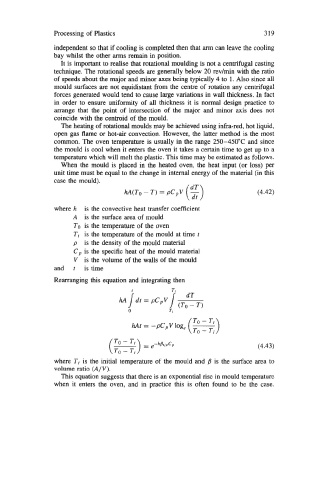
                   When the mould is placed in the heated oven, the heat input (or loss) per
                 unit time must be equal to the change in internal energy of the material (in this
                 case the mould).
                                                                               (4.42)

                 where h  is the convective heat transfer coefficient
                       A  is the surface area of mould
                       To  is the temperature of the oven
                       T,  is the temperature of the mould at time t
                       p  is the density of  the mould material
                       C, is the specific heat of the mould material
                       V  is the volume of the walls of the mould
                 and   t   is time
                 Rearranging this equation and integrating then


                                                                               (4.43)

                 where Ti is the initial temperature of  the mould and fi  is the surface area to
                 volume ratio (AIV).
                   This equation suggests that there is an exponential rise in mould temperature
                 when  it  enters the  oven, and  in  practice  this  is  often found to  be  the  case.

