


Page 341 - Plastics Engineering
P. 341
324                                            Processing of Plastics


                                                                    Pressure


                                                                 Houldikg

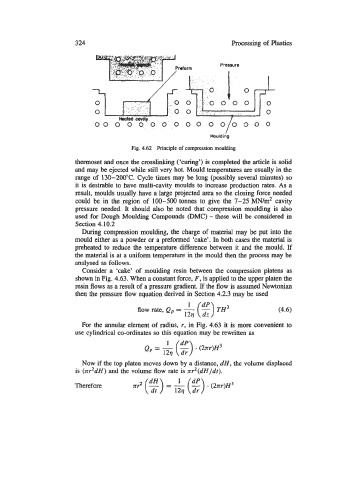
                                         Fig. 4.62  Principle of compression moulding
                        thermoset and once the crosslinking (‘curing’) is completed the article is solid
                        and may be ejected while still very hot. Mould temperatures are usually in the
                        range of  130-200°C. Cycle times may be long (possibly several minutes) so
                        it is desirable to have multi-cavity moulds to increase production rates. As  a
                        result, moulds usually have a large projected area so the closing force needed
                        could be  in  the region of  100-500  tonnes to give the 7-25  MN/m2 cavity
                        pressure needed. It  should also k noted  that  compression moulding is also
                        used for Dough Moulding Compounds (DMC) - these will be considered in
                        Section 4.10.2
                          During compression moulding, the charge of  material may be put into the
                        mould either as a powder or a preformed ‘cake’. In both cases the material is
                        preheated to reduce the temperature difference between it and the mould. If
                        the material is at a uniform temperature in the mould then the process may be
                        analysed as follows.
                          Consider a  ‘cake’ of  moulding resin between the compression platens as
                        shown in Fig. 4.63. When a constant force, F, is applied to the upper platen the
                        resin flows as a result of a pressure gradient. If the flow is assumed Newtonian
                        then the pressure flow equation derived in Section 4.2.3 may be used
                                                          1
                                           flow rate, Qp = - (E) TH3                  (4.6)
                                                         1217   dz
                          For the annular element of  radius, r, in Fig. 4.63 it is more convenient to
                        use cylindrical co-ordinates so this equation may be rewritten as

                                                    1   dP
                                             eP = - (-)  . (2nr)~3
                                                   1217   dr
                          Now if the top platen moves down by a distance, dH, the volume displaced
                        is (nr2dH) and the volume flow rate is nr2(dH/dt).

                        Therefore        nr2 (f) 1 (E) (2nr)~3
                                                    =
                                                      1217   dr

