


Page 344 - Plastics Engineering
P. 344
Processing of Plastics                                          327


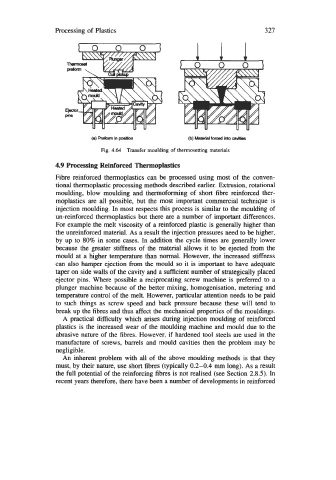
                            (a) pretorm in position       (b) Melerial forced into cavities
                               Fig. 4.64  Transfer moulding of  thermosetting materials
                  4.9 Processing Reinforced Thermoplastics

                  Fibre reinforced thermoplastics can be processed using most  of  the conven-
                  tional thermoplastic processing methods described earlier. Extrusion, rotational
                  moulding, blow  moulding and thermoforming of  short fibre reinforced ther-
                  moplastics are all possible, but  the most  important commercial technique is
                  injection moulding. In most respects this process is similar to the moulding of
                  un-reinforced thermoplastics but there are a number of  important differences.
                  For example the melt viscosity of a reinforced plastic is generally higher than
                  the unreinforced material. As a result the injection pressures need to be higher,
                  by  up to 80% in some cases. In addition the cycle times are generally lower
                  because the greater stiffness of  the material allows it to be  ejected from the
                  mould at a higher temperature than normal. However, the increased stiffness
                  can also hamper ejection from the mould so it is important to have adequate
                  taper on side walls of the cavity and a sufficient number of  strategically placed
                  ejector pins. Where possible a reciprocating screw machine is preferred to a
                  plunger machine because of  the better mixing, homogenisation, metering and
                  temperature control of the melt. However, particular attention needs to be paid
                  to  such things as screw speed and back pressure because these will  tend  to
                  break up the fibres and thus affect the mechanical properties of the mouldings.
                    A practical difficulty which arises during injection moulding of  reinforced
                  plastics is the increased wear of  the moulding machine and mould due to the
                  abrasive nature of  the fibres. However, if  hardened tool steels are used in the
                  manufacture of  screws, barrels and mould cavities then  the problem may  be
                  negligible.
                    An  inherent problem with all of  the above moulding methods is that they
                  must, by their nature, use short fibres (typically 0.2-0.4  mm long). As a result
                  the full potential of the reinforcing fibres is not realised (see Section 2.8.5). In
                  recent years therefore, there have been a number of developments in reinforced

