


Page 348 - Plastics Engineering
P. 348
Processing of  Plastics                                         33 1

                          Resin brushed on


                                                       cures inair


                    Layers of
                    resin ond
                    fibres
                         (a1 Basic  hand  lay-up  method


                           Flexible bag


                          Mould /      Mould V.         ‘Mwld
                                           ng
                                           I
                       IbIVacuum  bag        (cl Pressure bog
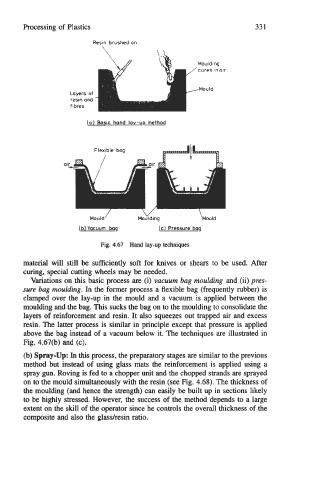
                             Fig. 4.67  Hand lay-up techniques

       material will  still be  sufficiently soft for knives or  shears to  be  used.  After
       curing, special cutting wheels may be needed.
         Variations on this basic process are (i) vacuum bug moulding and (ii) pres-
       sure bug moulding. In the former process a flexible bag (frequently rubber) is
       clamped over the lay-up in  the mould and a vacuum is applied between the
       moulding and the bag. This sucks the bag on to the moulding to consolidate the
       layers of  reinforcement and resin. It also squeezes out trapped air and excess
       resin. The latter process is similar in principle except that pressure is applied
       above the bag instead of  a vacuum below it. The techniques are illustrated in
       Fig. 4.67(b) and (c).
       (b) Spray-Up: In this process, the preparatory stages are similar to the previous
       method but instead of  using glass mats the reinforcement is applied using  a
       spray gun. Roving is fed to a chopper unit and the chopped strands are sprayed
       on to the mould simultaneously with the resin (see Fig. 4.68). The thickness of
       the moulding (and hence the strength) can easily be built up in sections likely
       to be highly stressed. However, the success of  the method depends to a large
       extent on the skill of the operator since he controls the overall thickness of the
       composite and also the glasshesin ratio.

