


Page 351 - Plastics Engineering
P. 351
334                                            Processing of Plastics


                                    Y  P   P  fibres of
                                              l
                                                 Y
                                                              Supply of
                                              ',  p,rotated                  (b)

                                                                              Heated
                                                                              mould


                                  Exhaust       \  \    \
                                   fan            Preform  \,   63
                                                  transferred \   /p
                                (a)               to mould   \,,


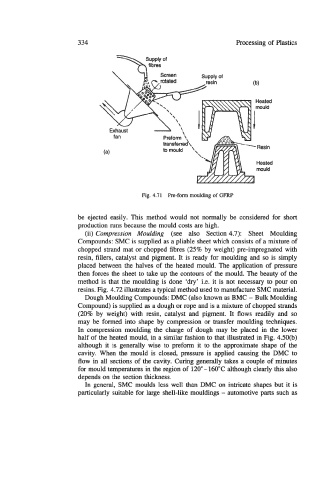
                                            Fig. 4.71  Re-form moulding of GFRP


                         be  ejected easily. This method would  not  normally be  considered for  short
                         production runs because the mould costs are high.
                           (ii) Compression  Moulding  (see  also  Section 4.7):  Sheet  Moulding
                         Compounds: SMC is supplied as a pliable sheet which consists of a mixture of
                         chopped strand mat or chopped fibres (25% by  weight) pre-impregnated with
                         resin, fillers, catalyst and pigment. It is ready for moulding and so is simply
                         placed between the halves of  the heated mould. The application of  pressure
                         then forces the sheet to take up the contours of  the mould. The beauty of the
                         method is that the moulding is done 'dry' i.e.  it is not necessary to pour on
                         resins. Fig. 4.72 illustrates a typical method used to manufacture SMC material.
                           Dough Moulding Compounds: DMC (also known as BMC - Bulk Moulding
                         Compound) is supplied as a dough or rope and is a mixture of chopped strands
                         (20% by  weight)  with  resin,  catalyst  and  pigment.  It  flows readily  and  so
                         may  be formed into shape by  compression or transfer moulding techniques.
                         In  compression moulding the  charge of  dough may  be  placed  in  the  lower
                         half of the heated mould, in a similar fashion to that illustrated in Fig. 4.50(b)
                         although it  is  generally wise to preform it  to  the  approximate shape of  the
                         cavity. When  the mould  is  closed, pressure is  applied causing the  DMC  to
                         flow in all sections of  the cavity. Curing generally takes a couple of  minutes
                         for mould temperatures in the region of  12W-160"C although clearly this also
                         depends on the section thickness.
                           In general, SMC moulds less well than DMC on intricate shapes but  it is
                         particularly suitable for large shell-like mouldings - automotive parts such as

