


Page 350 - Plastics Engineering
P. 350
Processing of  Plastics                                         333

       prepared fabric stack placed in the mould. The typical procedure is as follows.
       Release agent  and  gelcoat are applied to  the  mould  surfaces and  the  fibre
       fabric is laid  into the lower part  of  the open  mould. The activated resin  is
       then poured on top of the mat and when the mould is closed thb resin spreads
       throughout the reinforcement. High pressures are not necessary as the process
       relies on squeezing the resin throughout the reinforcement rather than forcing
       the composite into shape. A typical value of cycle time is about 10-15  minutes
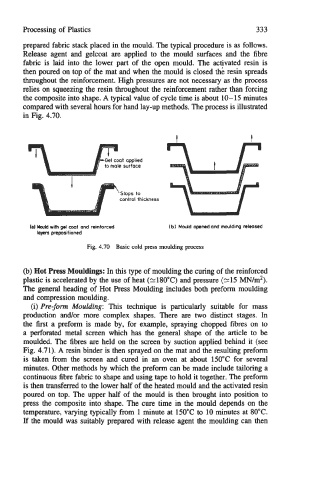
       compared with several hours for hand lay-up methods. The process is illustrated
       in Fig. 4.70.


                                  cantrol thickness


         lo1 would with gel  coat  and  reinforced   I bl Mould opend and moulding released
           layers pnpositioned
                         Fig. 4.70  Basic cold press moulding process


       (b) Hot Press Mouldings: In this type of moulding the curing of the reinforced
       plastic is accelerated by the use of heat (2:18OoC) and pressure (-15  MN/m2).
       The general heading of Hot Press Moulding includes both preform moulding
       and compression moulding.
         (i) Pre-fom Moulding:  This  technique  is  particularly  suitable  for  mass
       production  and/or  more  complex shapes. There  are  two  distinct  stages.  In
       the first a  preform is made by,  for example, spraying chopped fibres on to
       a  perforated  metal  screen which  has  the  general shape of  the  article to  be
       moulded. The fibres are held on the screen by  suction applied behind it (see
       Fig. 4.71). A resin binder is then sprayed on the mat and the resulting preform
       is taken  from the  screen and cured  in  an  oven  at  about  150°C for  several
       minutes. Other methods by which the preform can be made include tailoring a
       continuous fibre fabric to shape and using tape to hold it together. The preform
       is then transferred to the lower half of the heated mould and the activated resin
       poured on top. The upper half of  the mould is then brought into position to
       press the composite into shape. The cure time in the mould depends on the
       temperature, varying typically from 1 minute at 150°C to  10 minutes at 80°C.
       If  the mould was suitably prepared with release agent the moulding can then

